A Tale of Two Cities
Ed. Note: This is over 6000 words, so plan your time accordingly if you are going to read it. There are three parts. Part 1 is me babbling on about who knows what. Part 2 is Slab City. Part 3 is Bombay Beach. If you prefer to wait for a better version, I'll be revising it at some point and posting it on my main website: mwebphoto.com. Or you can just scroll down and look at the pictures. They tell stories as well. Please leave a comment if you have any thoughts.
Intro
The 95 project mostly concerns the swathe of environmental and cultural carnage that stretches along US Highway 95 from up in Canada all the way down into Mexico. But it also includes consideration of alternative ways of organizing society that have sprung up to try to fix, alleviate, or at least escape the ongoing climate disaster that will likely decimate, or worse, the human population on earth in the not too distant future.
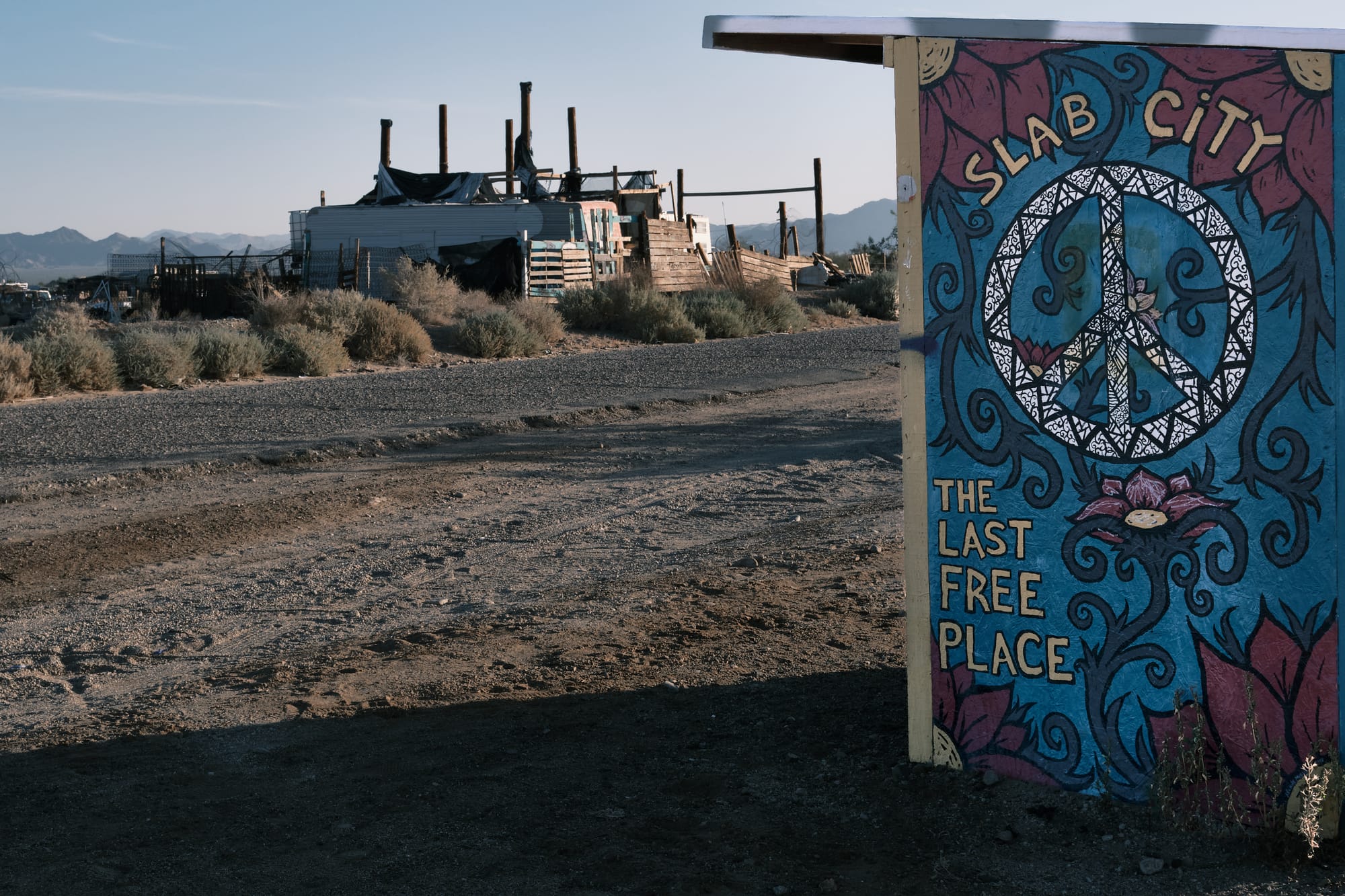
Slab City and Bombay Beach, two California towns near the Salton Sea, are places where alternative forms of society have either sprung up from below or been organized from above. They are only twenty miles apart geographically. Culturally, they are close in some ways, but couldn’t be much further apart in others.
The terrible things along the road are not particularly unique to the western United Sates. Humans are destroying and desecrating life everywhere on this planet and have been for a long time. But I think the defilements are easier to see and understand out here where the sky is big, life is sparse, and where there is not enough water to grow the trees that obscure the forest like in so much the rest of the world.
95 is like a wound down the spine of our current civilization. Sutures are applied, but the thread used to hold them together is always unraveling. Most of what we see along the road is either gaping wounds or scar tissue grown over to cover traumas past.
A long history of toxic philosophies that have brought us to this tipping point. Money, religions, wars of conquest, colonialism, and manifest destinies brought us the Industrial Age, Capitalism, consumer culture, and ultimately Neoliberalism, the latter of which is hastening our downfall at a rapidly expanding pace.
Philosophically, I am a Naturalist. Naturalism is the belief that everything that exists is, umm, natural and can be explained by science. Any claim to the supernatural is just bunk. There is no such thing as magic, or super beings who control the universe or anything else. If we can’t explain something that is because we haven’t figured it out, not because it is inexplicable.
Politically, I am not anything. I consider myself a pragmatist in that I believe we should be doing what works. So the 95 project is not just about illustrating what is wrong, but also about possible alternatives. I’ll be looking at various alternative communities, both past and present, along the road to see how they work and if something similar could work as a solution to Capitalism and Neoliberalism going forward.
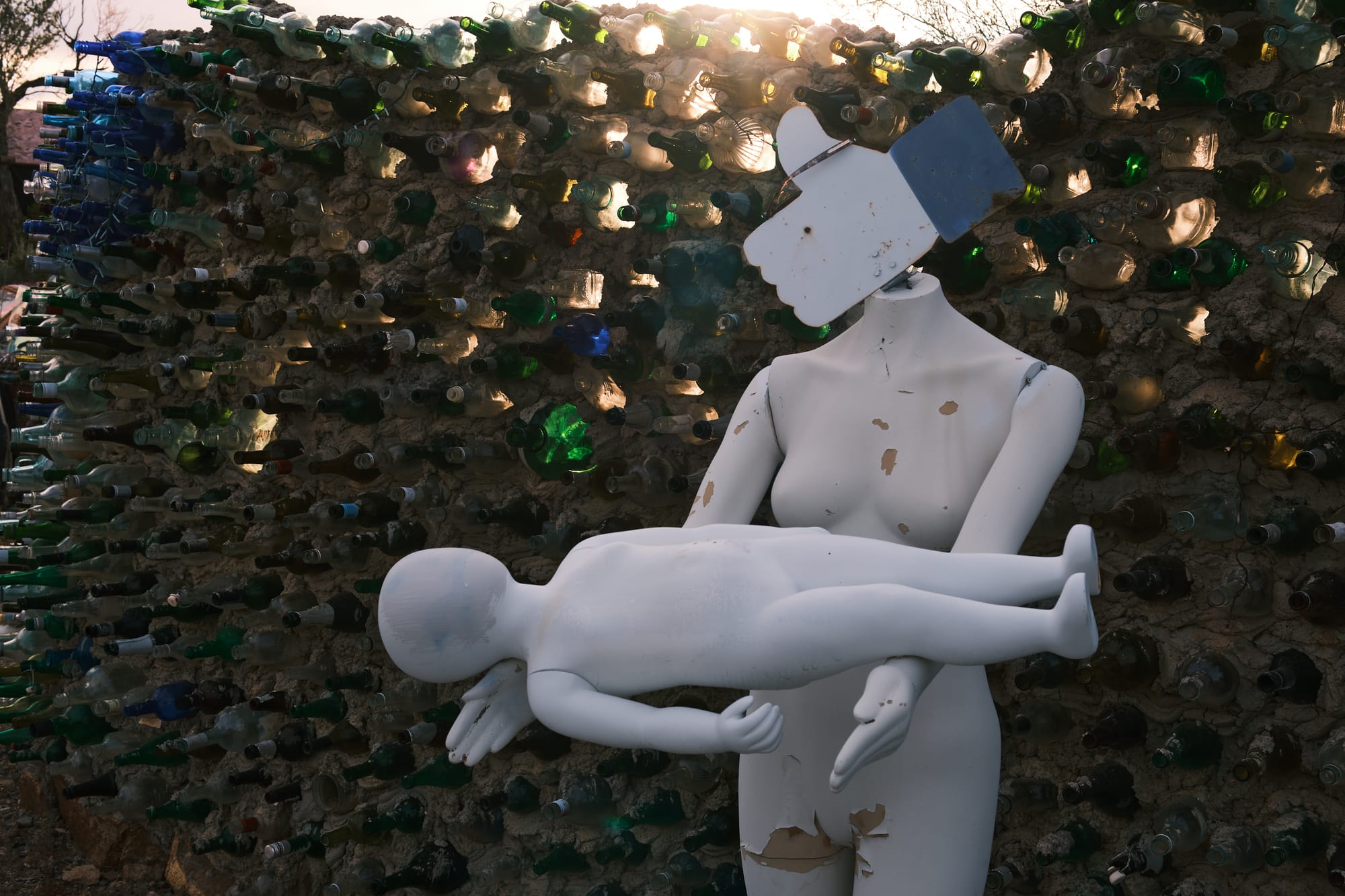
Although I am not a strong believer in much of anything outside of Naturalism, I will touch on various theories and proposals about how life was, is, and should be that may not or may not be strictly Naturalist. For example, at some point down the road we’ll consider Animism, as that was a common belief among many people along the road, and among people all over the planet for just about as long as there have been people.
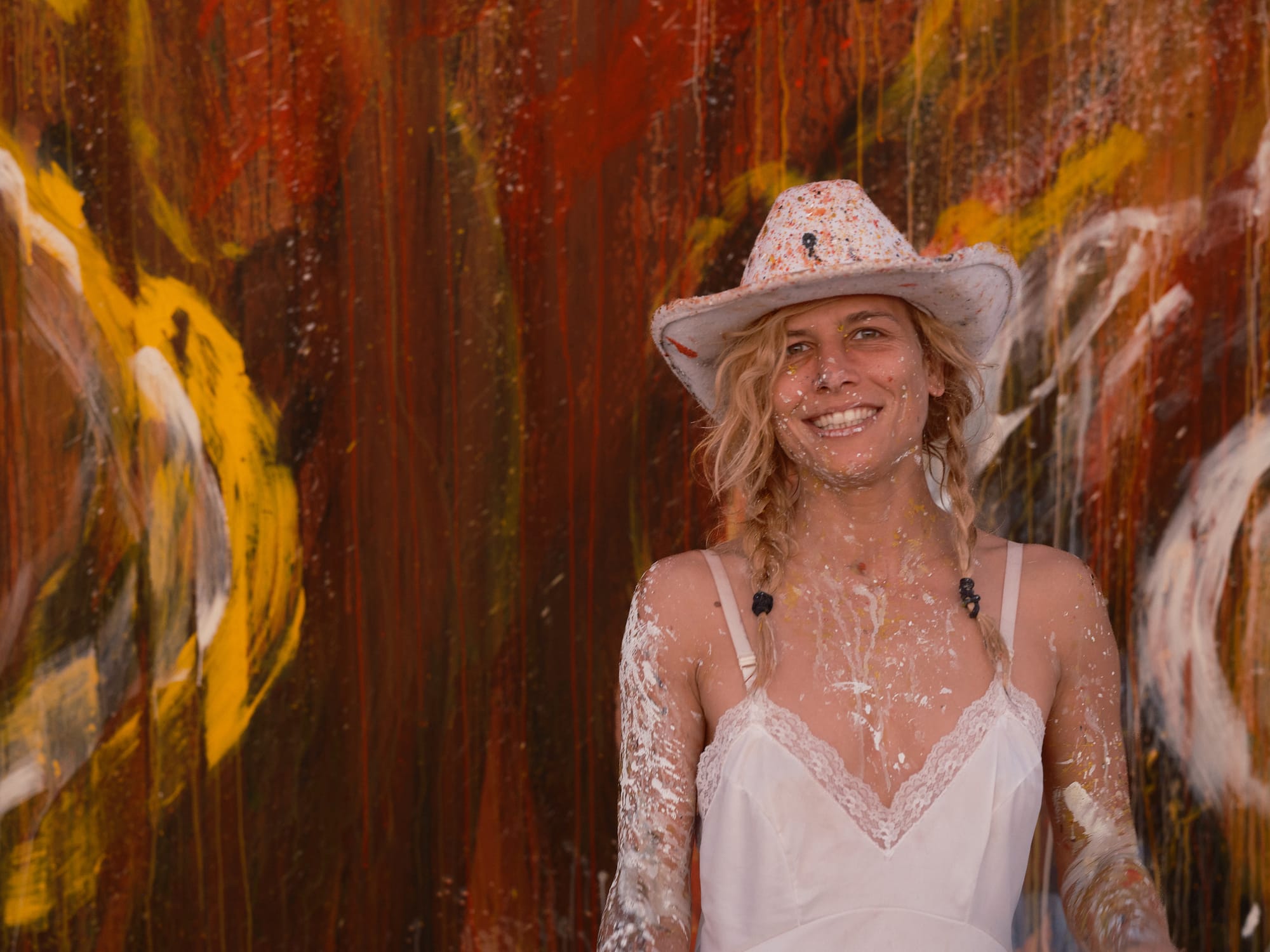
An example of a theory that fits with Naturalism and possibly Animism alike is the Gaia theory. It will serve as a kind of umbrella metaphor for the 95 project. The Gaia theory posits that the Earth is a living being, that its soil, waters, and atmosphere function as a single entity that maintains conditions that are suitable for all other life. In that scenario, the planet is much like our human bodies which are composed of trillions of tiny organisms that all do their own thing, but add up to a more encompassing entity – ourselves. Same thing with Gaia. The soil, water, atmosphere, and living things of this planet cohere into a larger being that we call the earth. That doesn't mean it has sentience, or at least any kind of sentience we can yet understand, but like a plant or other possibly non-sentient life, it has some defense mechanisms that come into play when its health is threatened. Like now.

If the planet is a living being, then it follows that global warming is a defensive mechanism and humans are an infection that the earth’s immune system is gearing up to fight. In short, the earth is starting to run a fever to kill the infection – us.
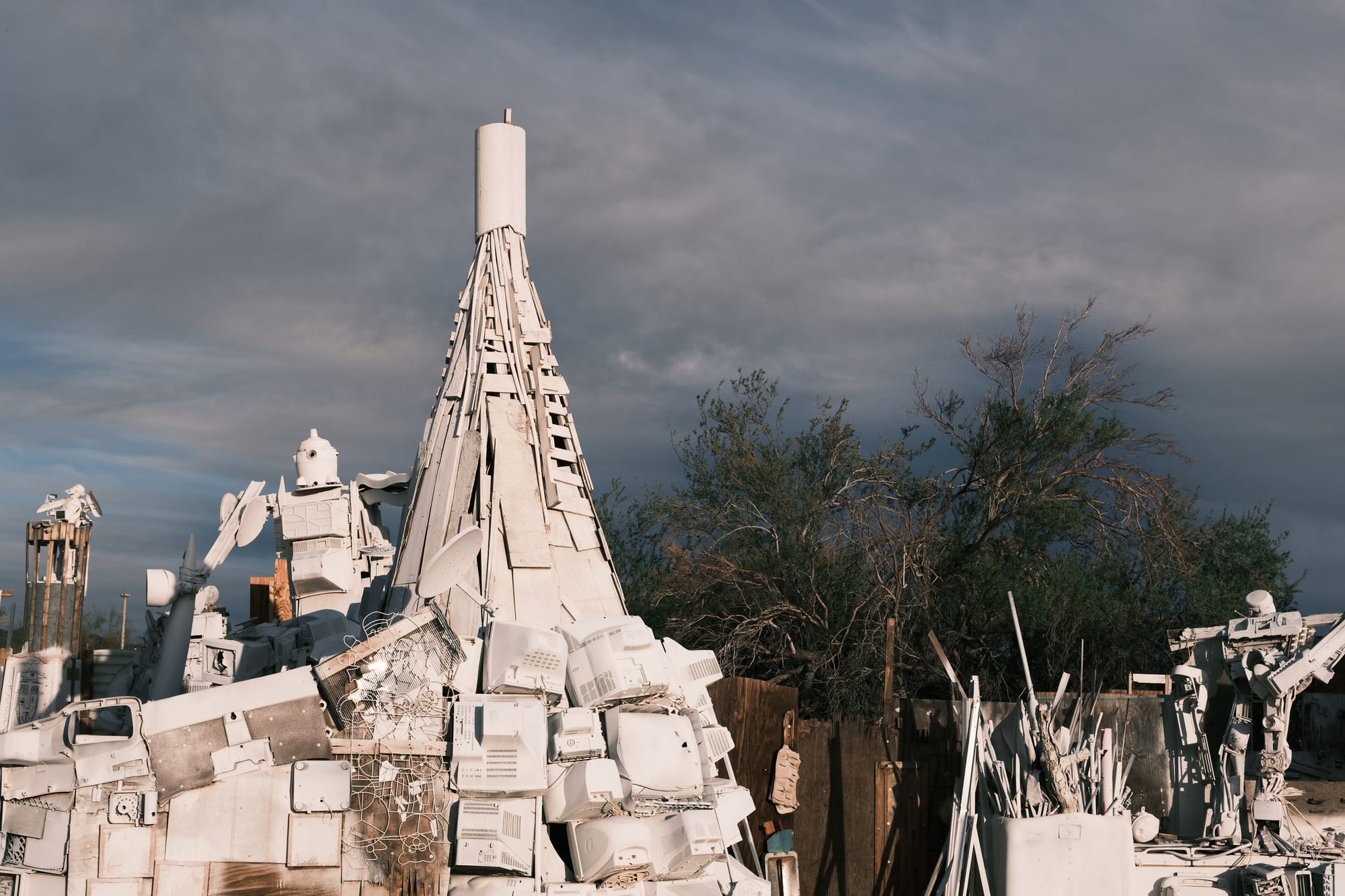
The human population was roughly 1 billion at the start of the Industrial Revolution. It is over 8 billion today and expected to peak around 11 billion towards the end of the century. Humans are like a rapidly spreading virus, causing ever more damage to our host.
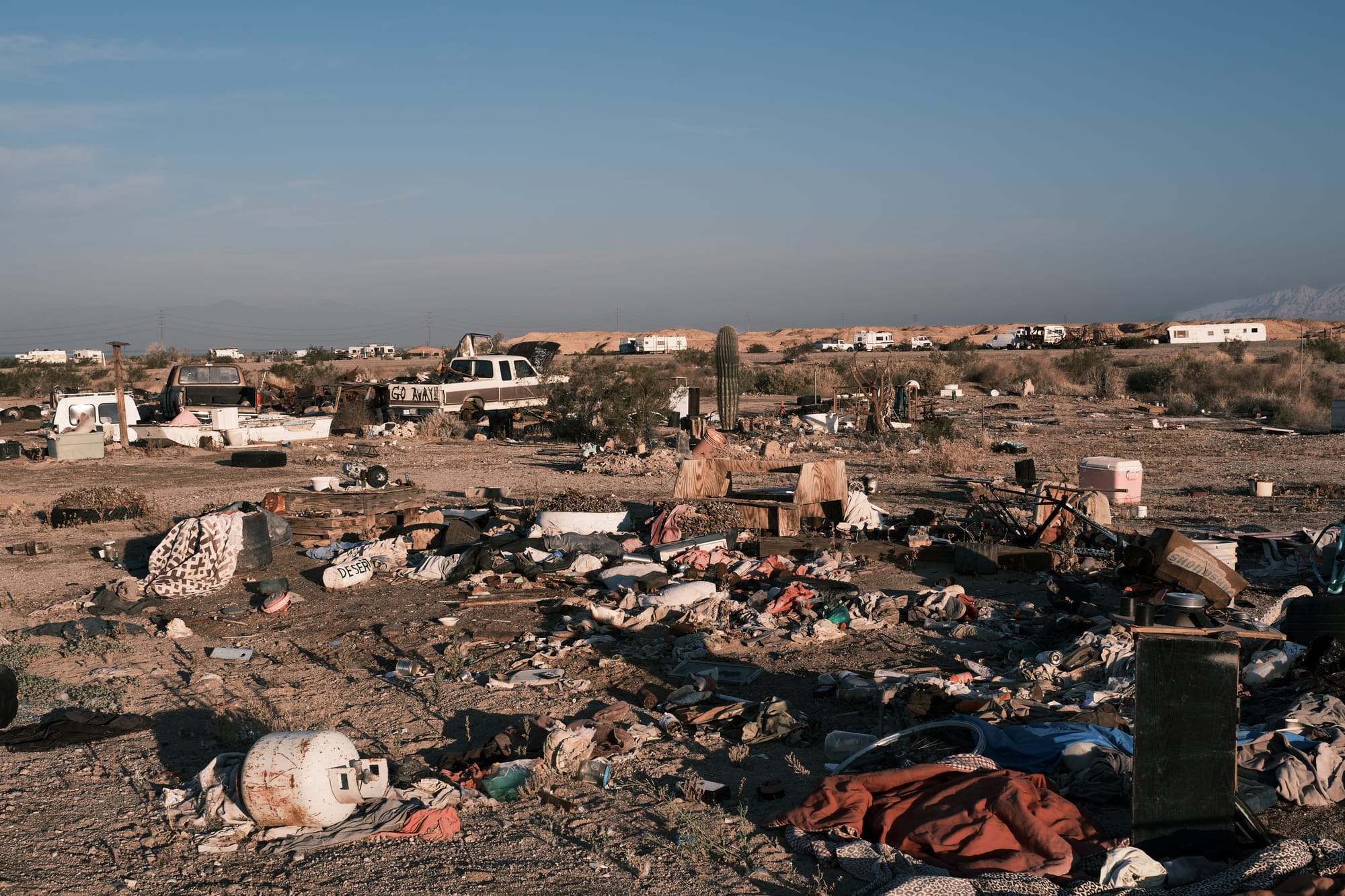
As the earth’s fever rises, it unleashes terrible storms, droughts, fires, floods, diseases and plagues that will continue to worsen and intensify as it gets hotter and ever less survivable for human life. It is likely our current civilization will collapse and we will be forced to come up with different living arrangements if we are to stop the fever, or survive it.
For that to happen, Capitalism, and its malformed child Neoliberalism, will have to go. Don’t get me wrong. I am not some kind of Communist or Maoist or Pol Pot expounding a version of Marxist political thought. It’s simply a matter of pragmatism. Global warming is the ultimate tell that Capitalism doesn’t work and in the long term it will kill us all if we can’t come up with an alternative.
In theory, Capitalism is a socio-economic system based on private property rights, with economic decisions made largely through the operation of a competitive market unregulated by the state. Neoliberalism takes it further by extending the principles of Capitalism into all aspects of human life. Neoliberals believe that it is rational, and a very good thing, for humans to always make decisions based on our short-term economic interests, which is obviously bunk, yet somehow flies.
The Capitalist system requires constant economic growth to function. Economic growth is the only measure of a society's health and success. It must be perpetual.
Population growth is necessary to sustain perpetual economic growth. Stability is failure and will cause recession or worse, negative growth and economic depression. We need more people making and consuming more things in perpetuity.
That is one of the more important foundational lies of Capitalism. Perpetual growth is obviously impossible, at least for as long as we are limited to one planet, which is forever. And it’s not just impossible, the effort to maintain it is catastrophic.
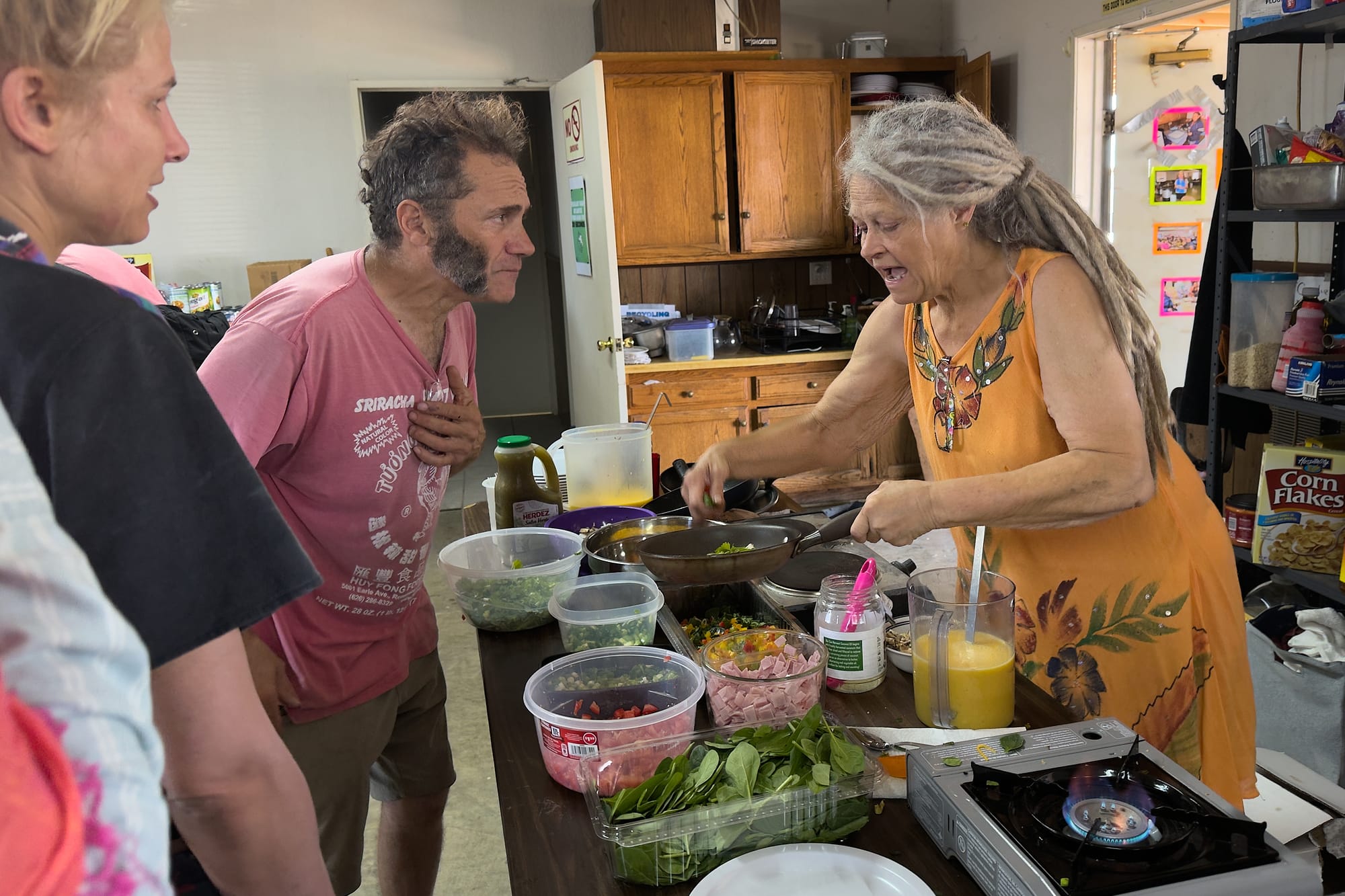
In short, Capitalism is a scam that will leave almost half of us high and dry and the other half underwater.
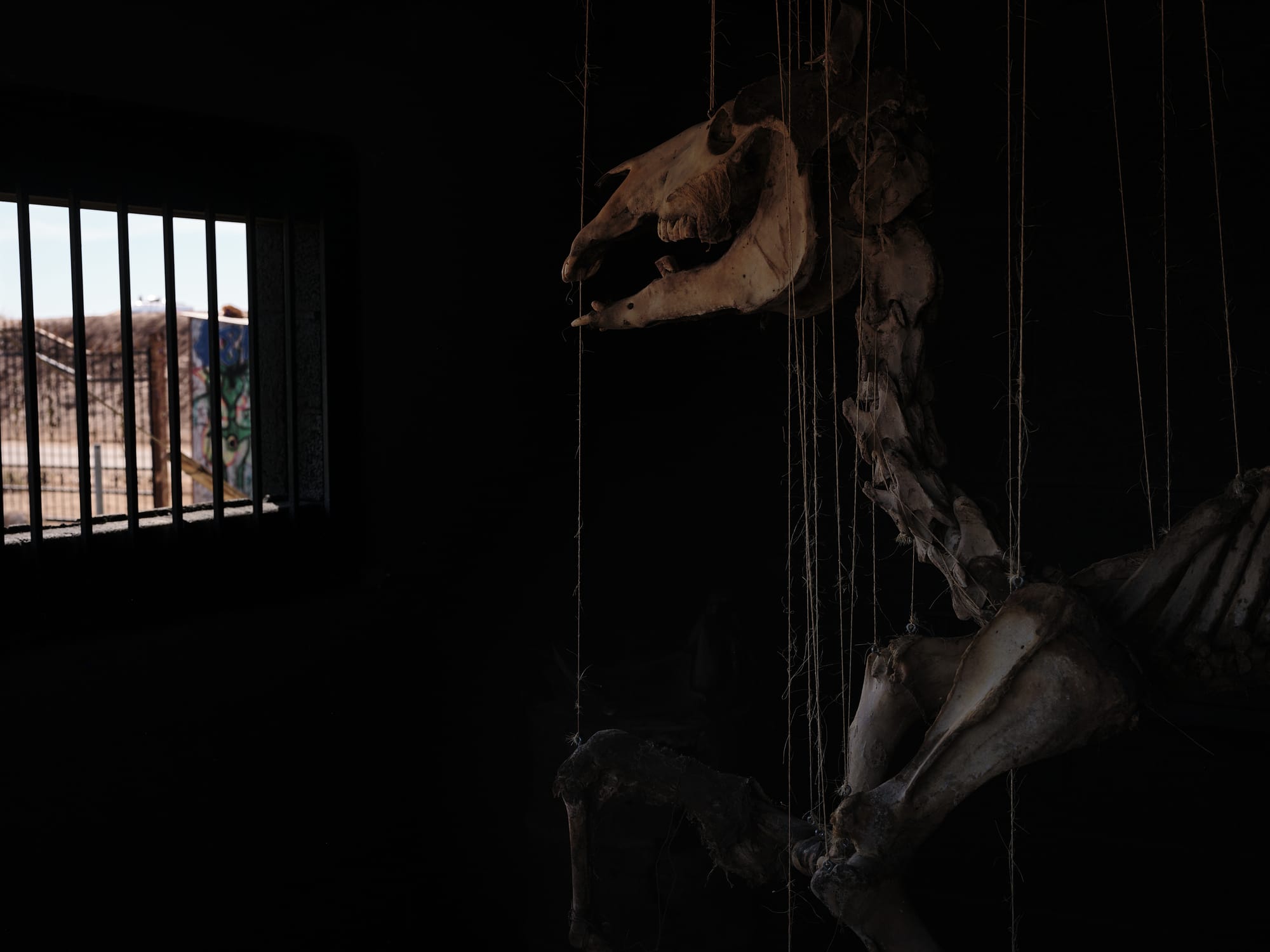
And the worse case scenario, for us at least, is that if we don’t find better ways of organizing society, it could be lights out for humanity.
*****
I've been reading Ursula K. Leguin for my entire adult life and she was quite possibly the foremost thinker about different ways to organize society. The Dispossessed, Always Coming Home, The Ones Who Walk Away from Omelas, The Telling, and The Word for the World is Forest all explore different social arrangements. She has been a huge influence on my thinking about these matters.
David Graeber is another contender. His and David Wengrow's "The Dawn of Everything" surveys our human past for alternative examples of social organization and places Capitalism and Neoliberalism as relatively recent inventions that are not at all as inevitable as the Capitalists and Neoliberals would have you believe. Graeber and Wengrow demonstrate that other forms of government are not only possible, but actually more common in human history. Capitalism as we know it is just a blip. Much of Graeber's other work, particularly Debt: the First 5000 Years, touches on the subject as well.
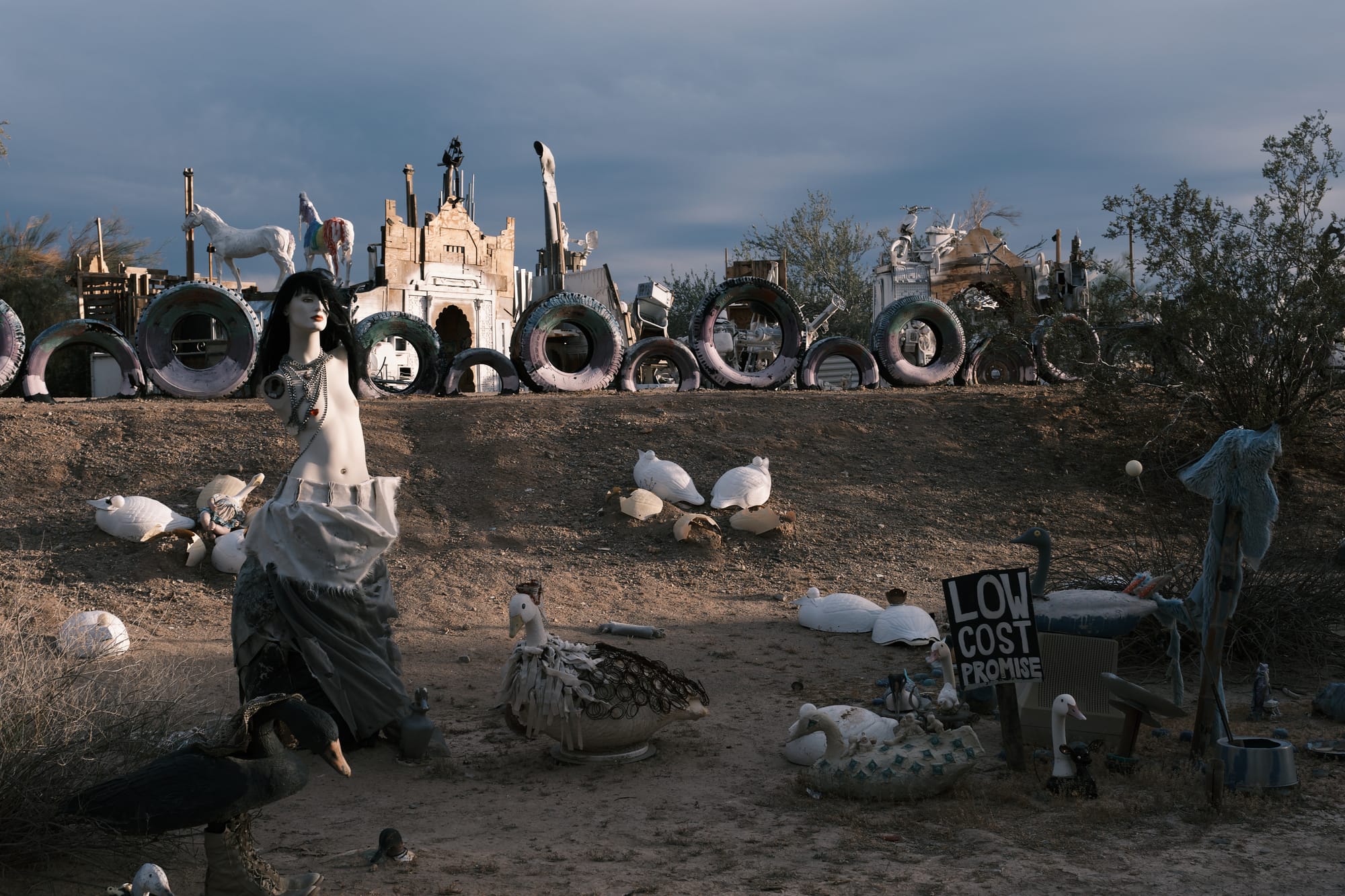
And I grew up not far from New Harmony, Indiana, which was the home of two, arguably three utopian experiments. I’ve studied the town and its history since going on field trips in grade school and that is a major influence as well.
Unfortunately, and this is what we are up against, these experiments in alternative societies, however successful, are always under attack, whether from internal or external forces.
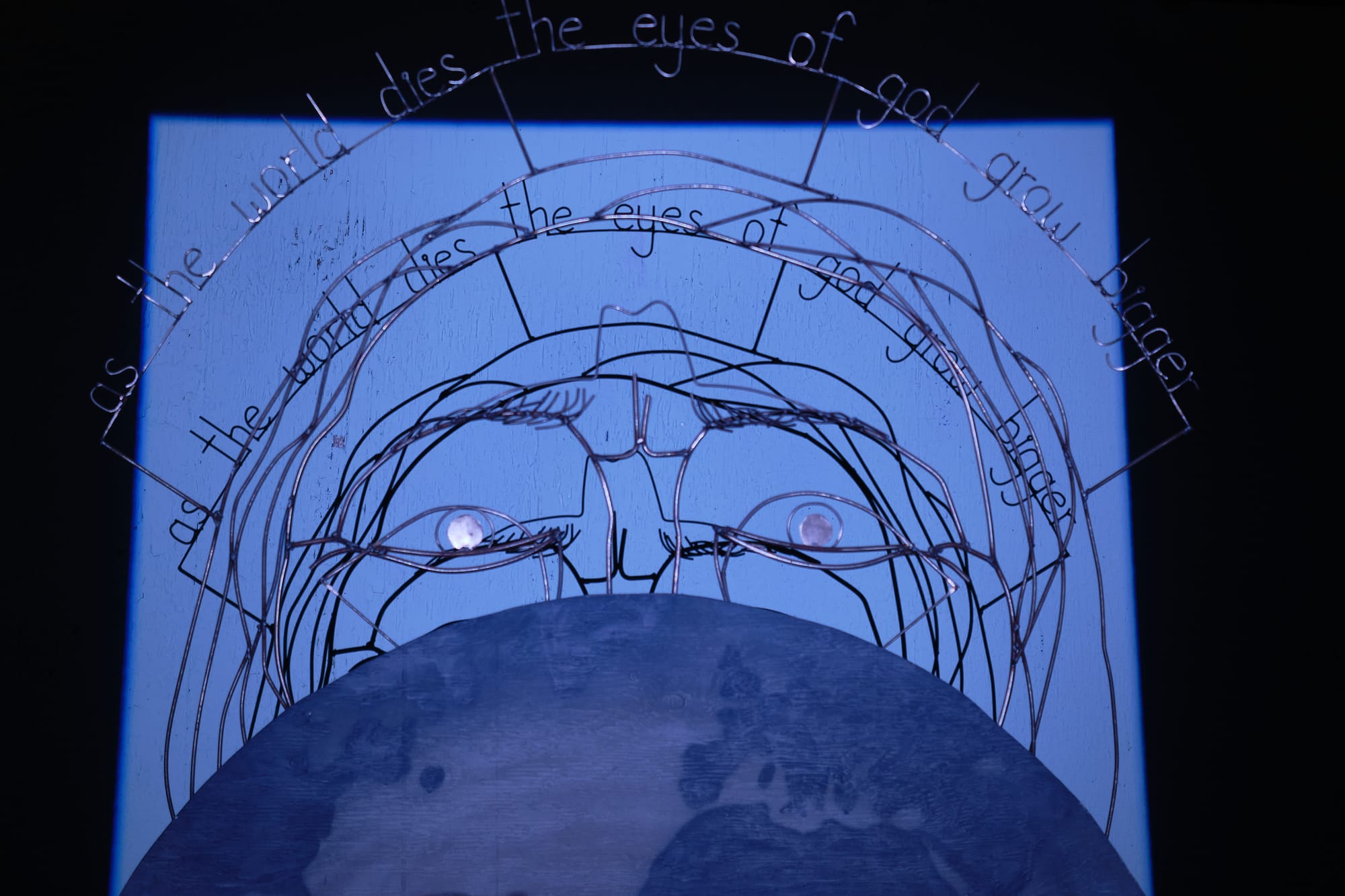
Perhaps the primal foundational lie that we are up against is the belief that humans are special beings who stand apart from other life on earth, when the fact is that we are great apes who are prone to violence and blindly following the meanest, dumbest leader with the gnarliest big red ass. If we can't overcome that nonsensical belief and deal honestly with where we came from, our chances of avoiding catastrophe are almost nil.
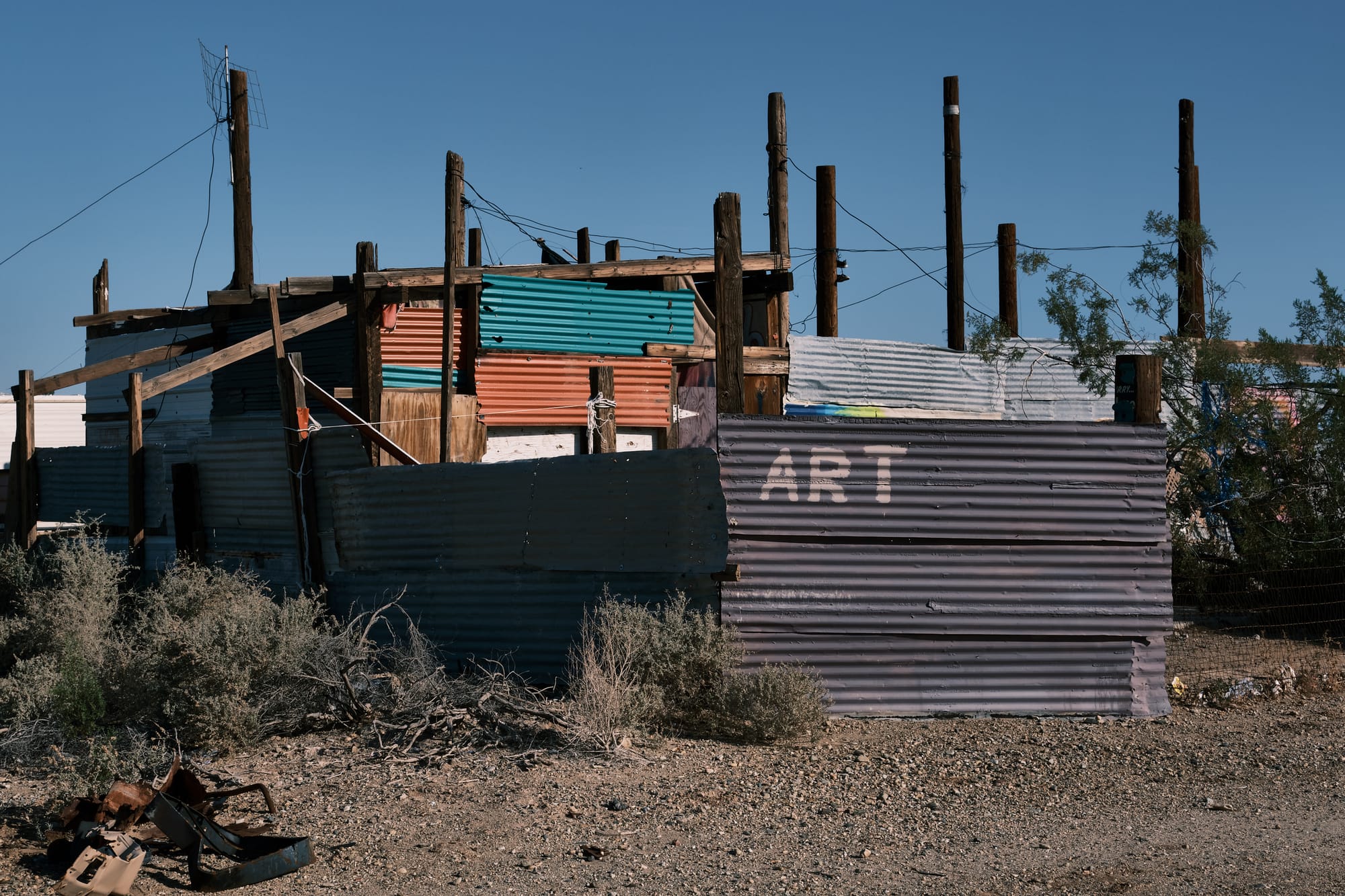
But the past, and to a lesser extent the present, of peoples along the road do offer some alternatives in which our ape-like natural impulses have been circumvented. So I’ll also try to present the more optimistic view that we are capable of stopping ourselves, and explore these possibilities, starting with Slab City and Bombay Beach.
Slab City
Slab City is an anarchist community that grew up on an abandoned military base between the Salton Sea and the Chocolate Mountains. I don't mean to imply it was planned as an anarchist community or that it was created or is inhabited by actual anarchists, neither the black-clad intellectual type or the camo-clad paranoid type, though there are a few of both.
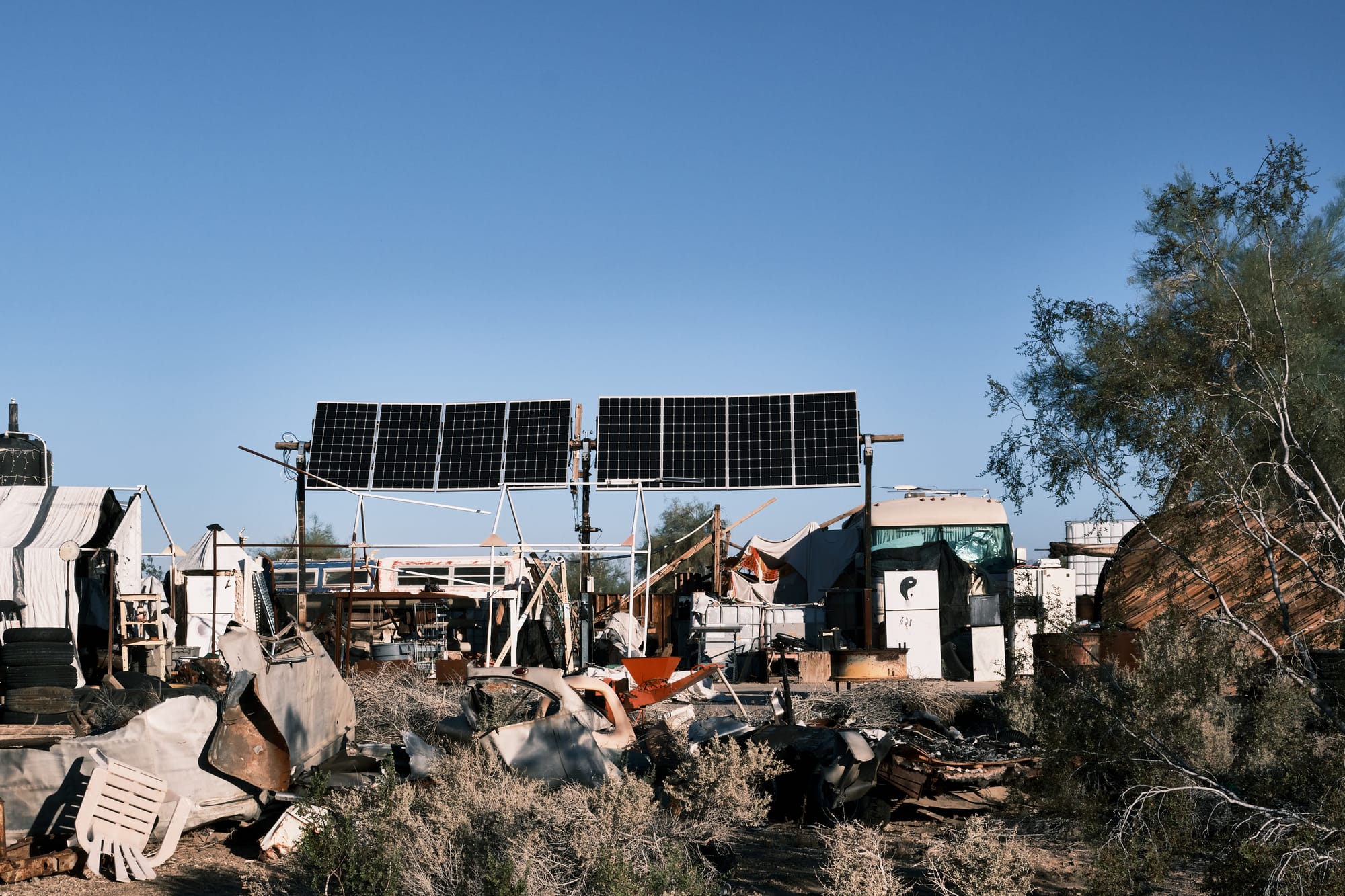
Slab City is an anarchist community because there is no government. No water, no sewage, no electricity, no police, no nothing that comes from government. The residents have to provide for themselves, which is not easy in one of the more hostile deserts surrounded by environmental tragedies on all sides.
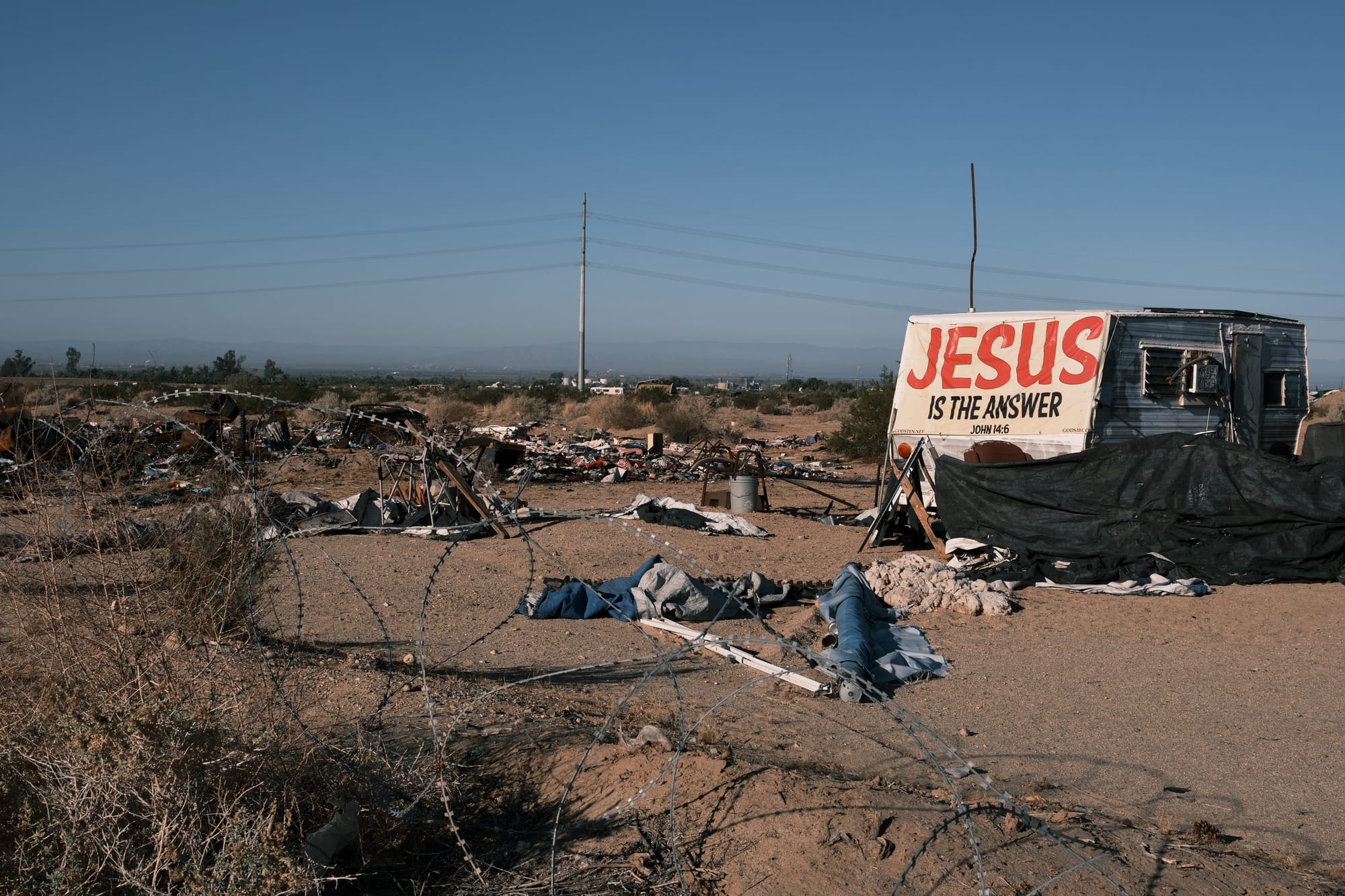
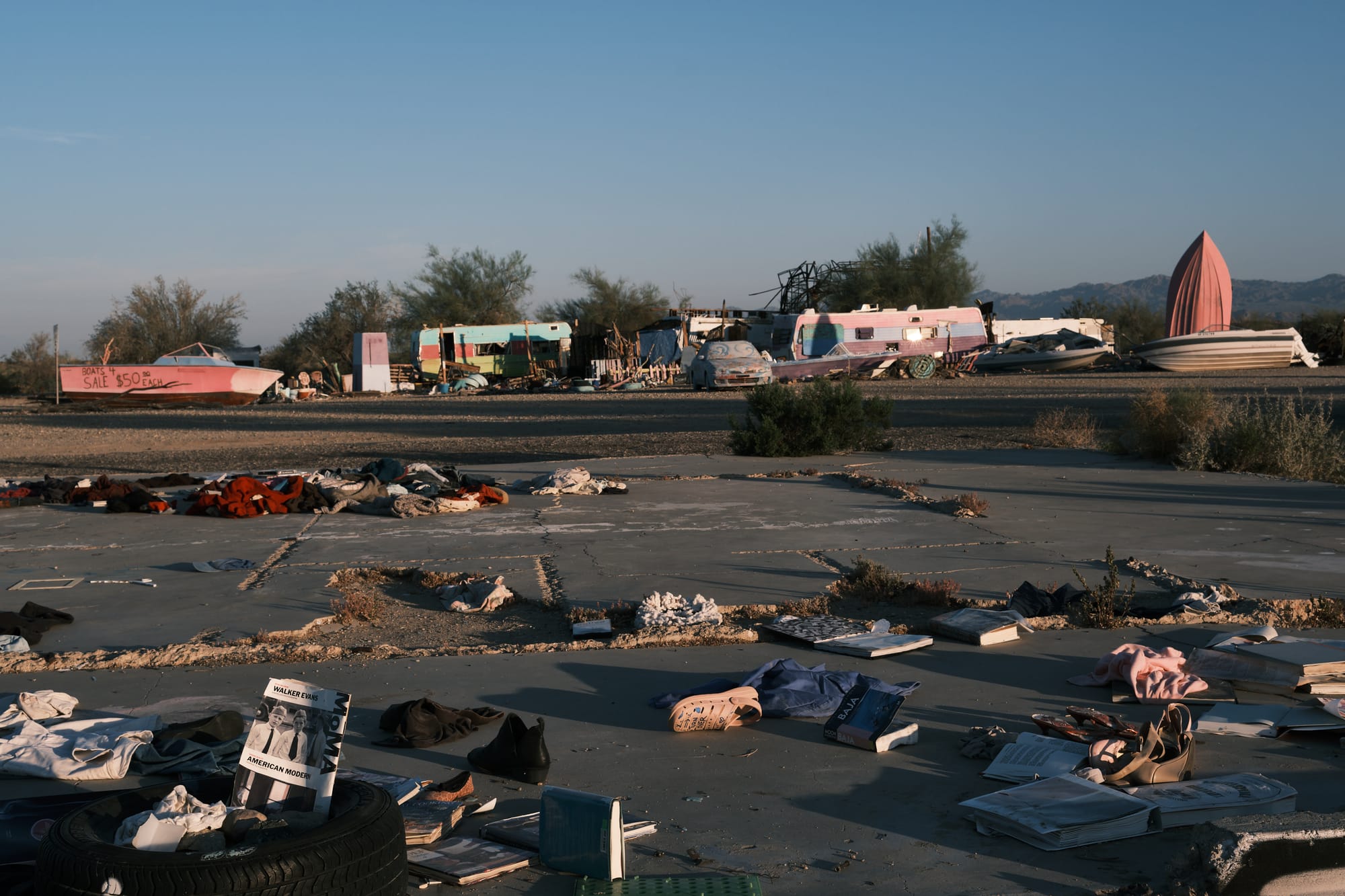
I’ll write a lot more about the Salton Sea in a different piece, but to understand Slab City (and Bombay Beach) you have to know that the Salton Sea is an environmental disaster that stinks all the way to the slabs. In the absense of oxygen, decomposing algae, agricultural runoff, and biological waste team up to produce hydrogen sulfide, the classic rotten egg smell, along with methane and various other volatile compounds. The summer temperature around the sea averages about 110F and regularly tops 115 and even goes as high as 120. When the weather gets hot and the wind blows towards the slabs, the stink is overpowering. To the east is Cowschwitz, a giant industrial cow farm that smells like cow shit from 25 miles away when it's hot and the wind blows from that direction. The Chocolate Mountains have been absconded by the military and are used as a practice range for blowing stuff up. The sound of screaming jets and loud explosions that light up the night sky are common. Slab City is not what most people consider a desirable place to live.
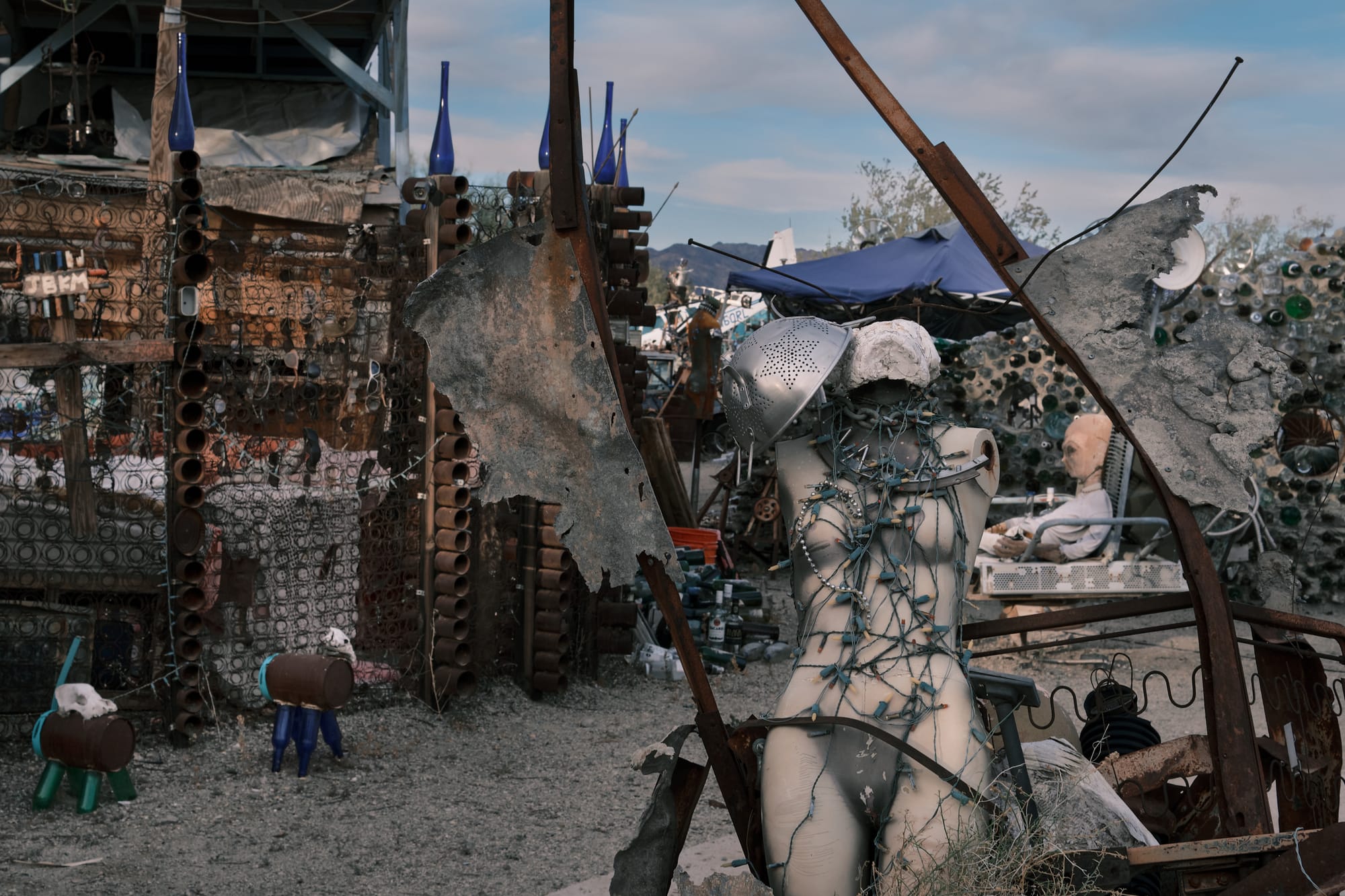
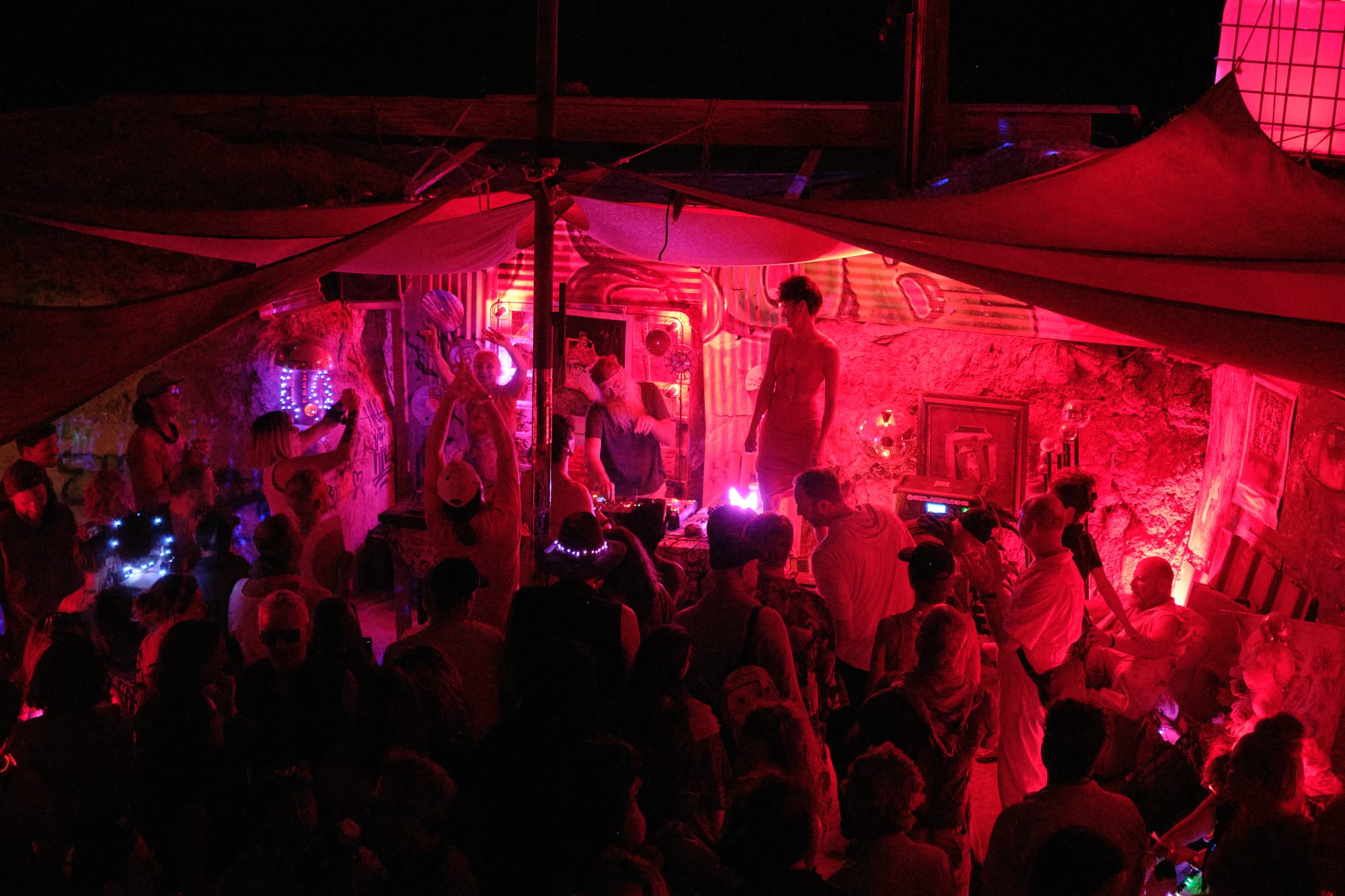
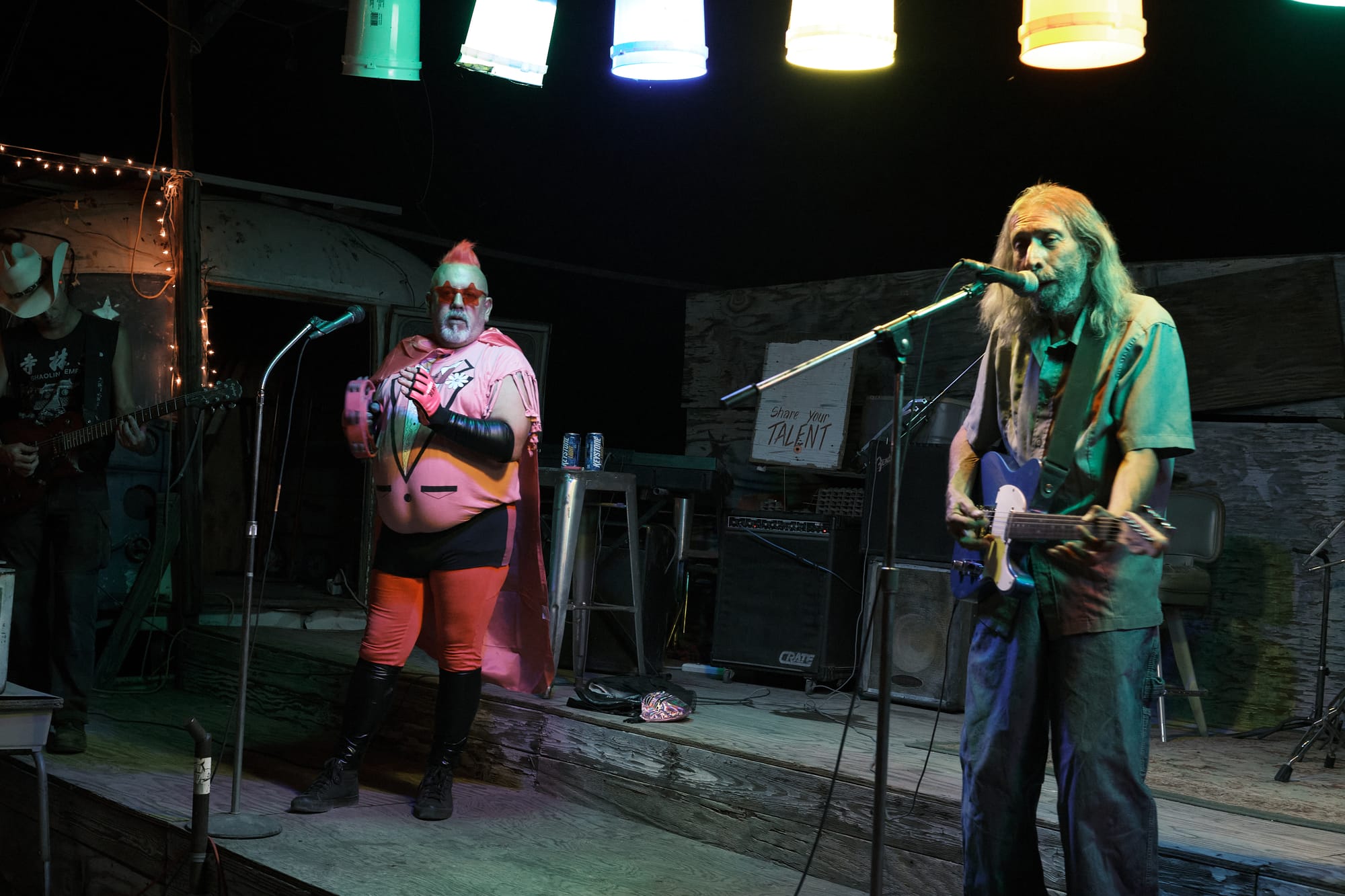
People come to Slab City for a variety of other reasons. Common motives include to do drugs and/or to hide from the law. Some just want to live off the grid and outside of society. Some come to make, or enjoy, art or to spread the word of Jesus. A few are do-gooders there to help the most desperate and downtrodden. Most are ruin porn tourists just passing through, like me, or influencers looking for a place for an offbeat photoshoot. Some are journalists or the like working on projects, also like me.
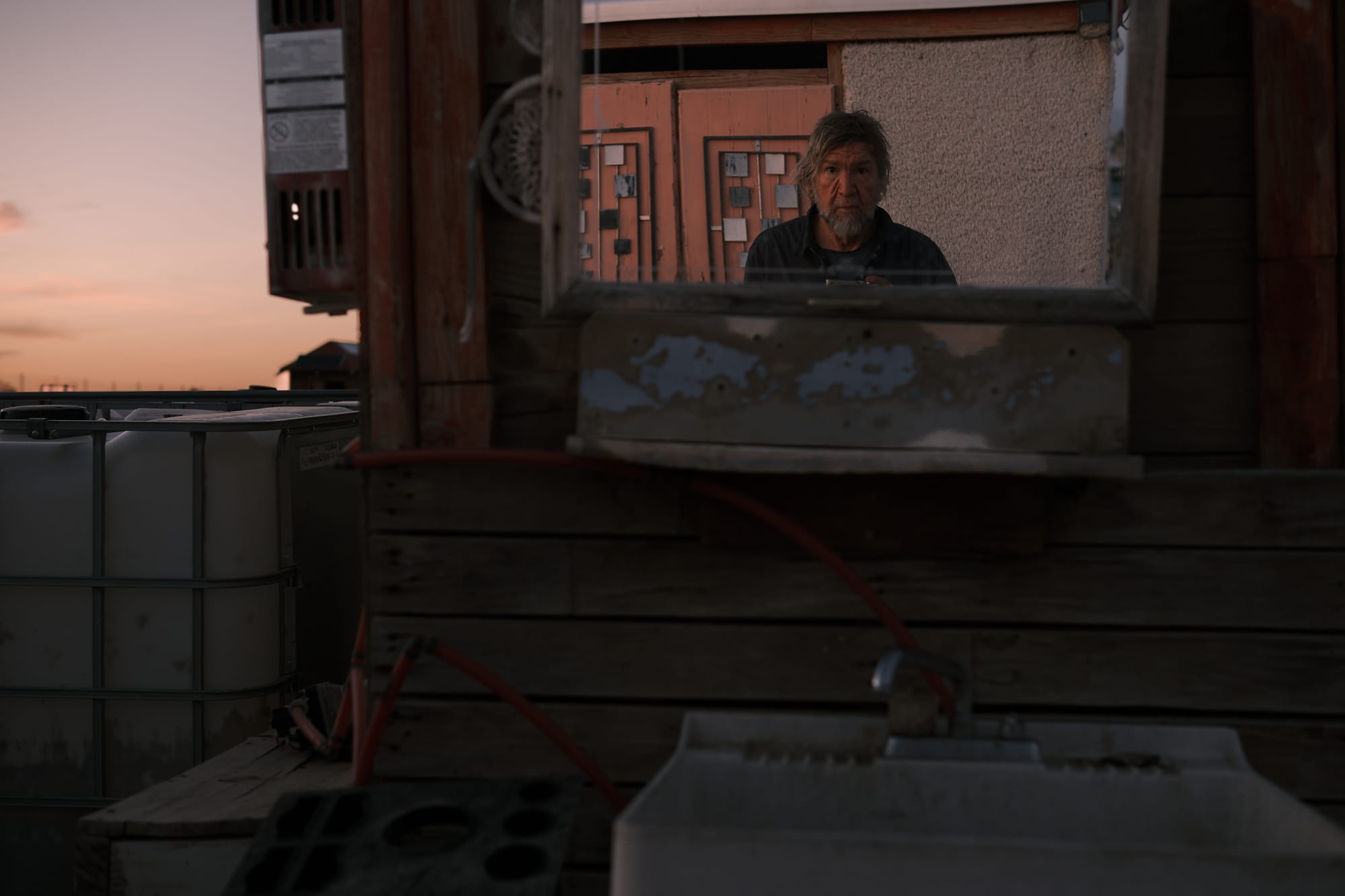
In normal America, people look twice at me to see if I’m a homeless person. In Slab City people can see in just a glance that I’m not.
There are levels to the drug use. Hard core addicts live in holes in the ground or abandoned rv’s or third world type wooden shacks and do little but get high. Fentanyl is the big thing and it is in every other kind of drug, often including cannabis. The Fentanyl is almost always cut with Xylazine, or “tranq,” a dangerous animal sedative that makes the Fentanyl cheaper and more addictive. Others mostly just drink a lot and/or smoke dope.
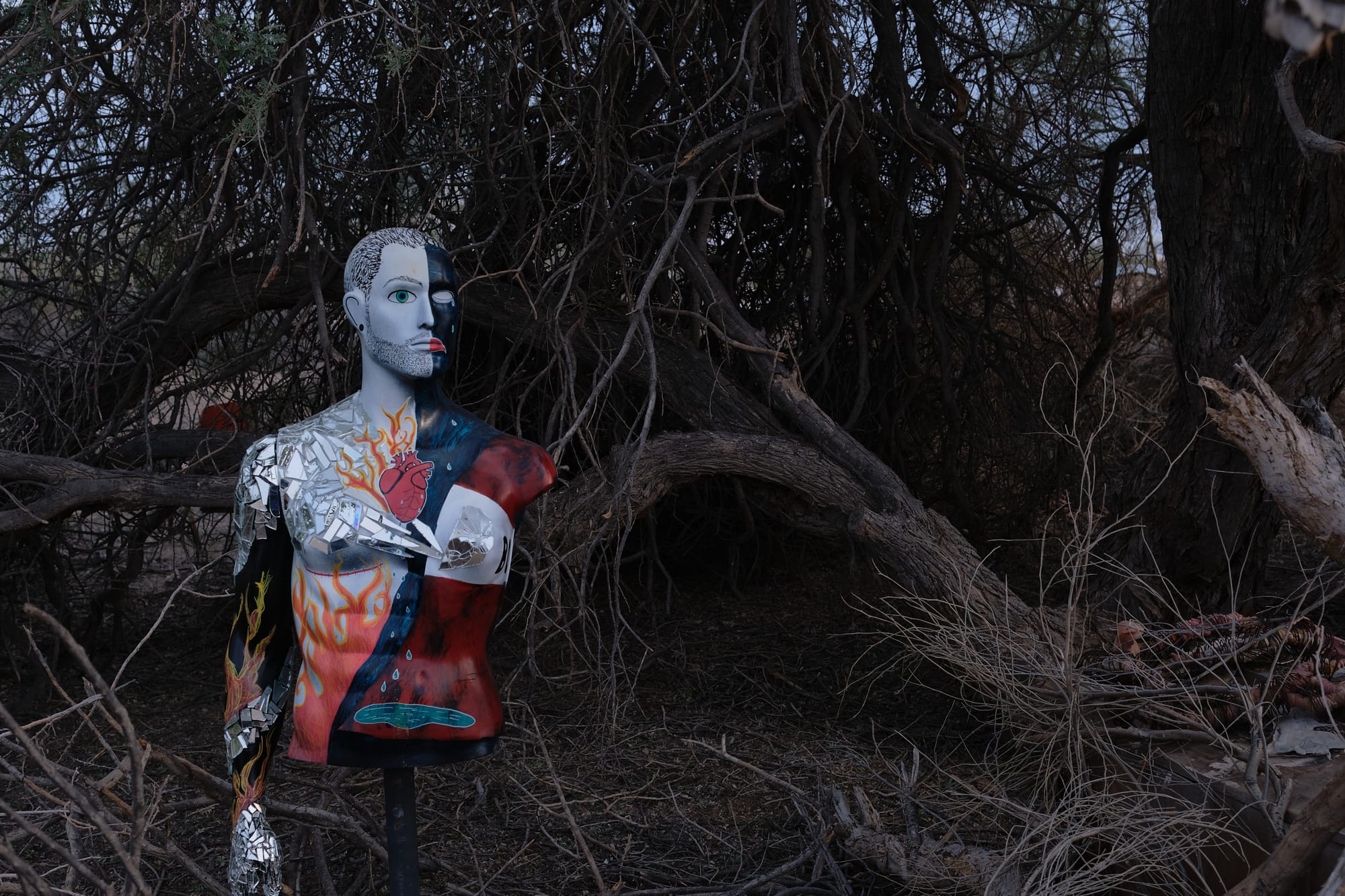
For a lot of the residents, Slab City is the end of the line. It’s the place where the car they were living in broke down. They have no way of getting out and nowhere to go if they did. There seemed to be a lot of trans people and queer kids. The year round population is roughly 150. It balloons to around 650 in the cooler months. A lot of people just pass through to party for awhile and live a bit dangerously, but they have choices unlike a lot of those who have to deal with the summer heat.
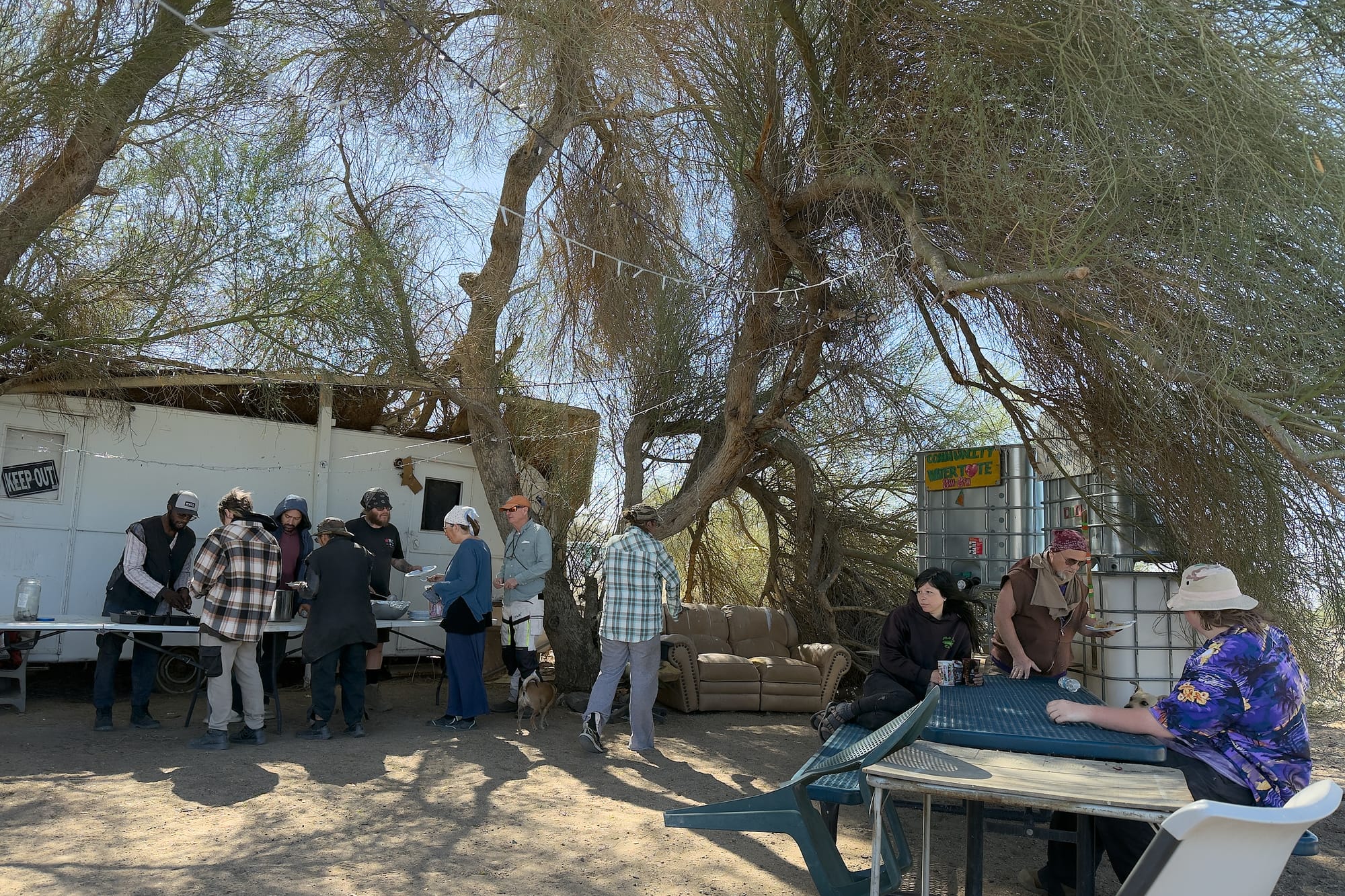
There is also a layer of residents who are do-gooders, providing a modicum social services - free meals, harm reduction, a library, among other things.
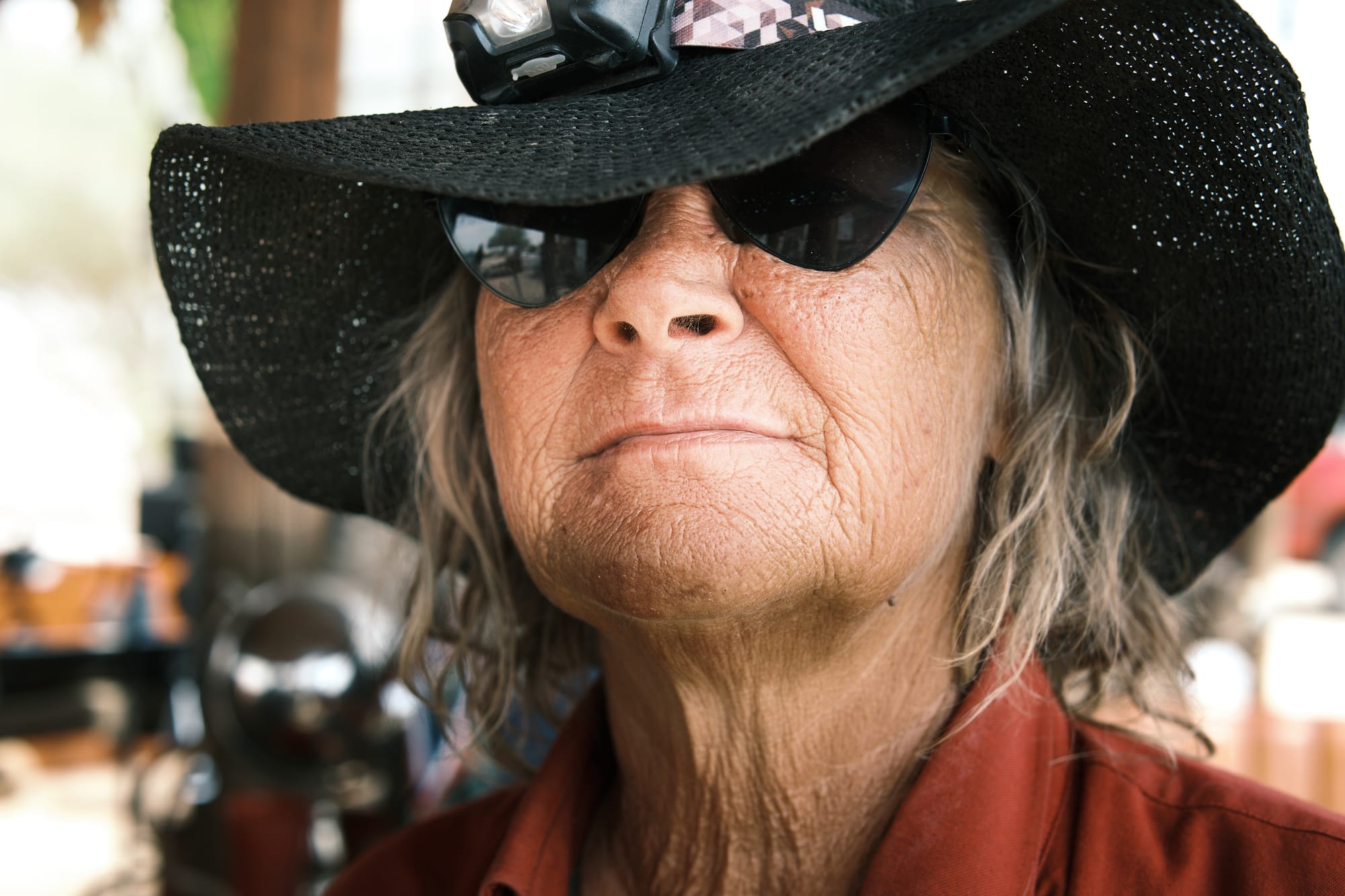
There is also an art scene with two noteworthy projects. Salvation Mountain on one end of town, East Jesus on the other.
Salvation Mountain is the work of Leonard Knight, a farm boy from Vermont and Korean War vet who had a religious experience when he was 35 and spent 10 years building a hot air balloon painted with the words “God is Love.”
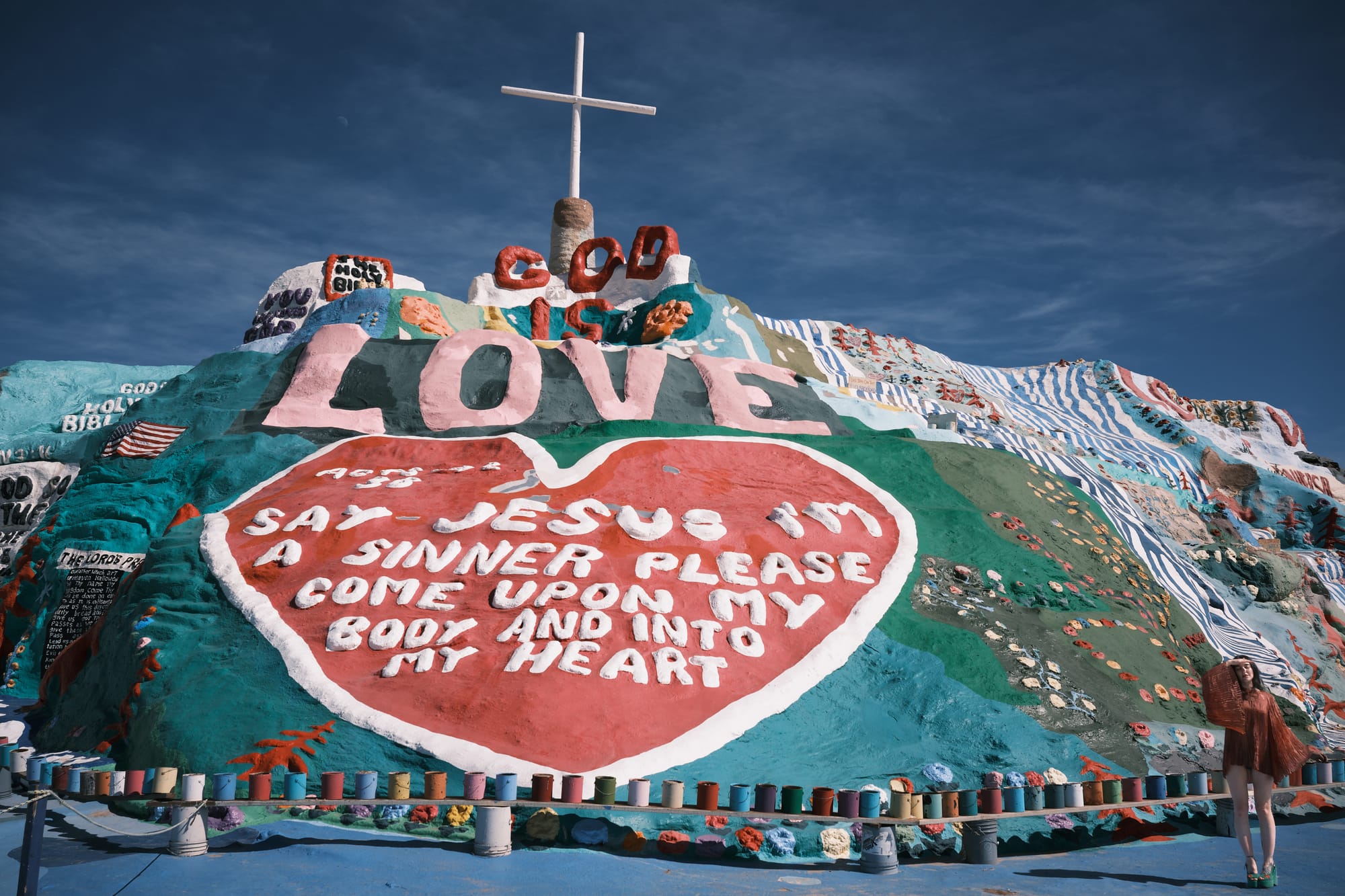
After all that work, the balloon didn’t fly so he moved to Slab City and spent 28 years building Salvation Mountain, a 50 foot tall and 150 feet wide hill built out with hay bales, old tires, and whatever salvaged items he could find, then covered with adobe and painted with 100,000 gallons of donated paint.
As Christian nutcases go, Knight was pretty cool. His entire message was painted on the mountain as you can see in the photo above. He didn’t try to convert people. He didn’t charge admittance. He inspired a lot of people to help him, from delivery drivers to Bay Area artists. One such artist was Charlie Russell who came to help with Salvation Mountain and stayed to create East Jesus.
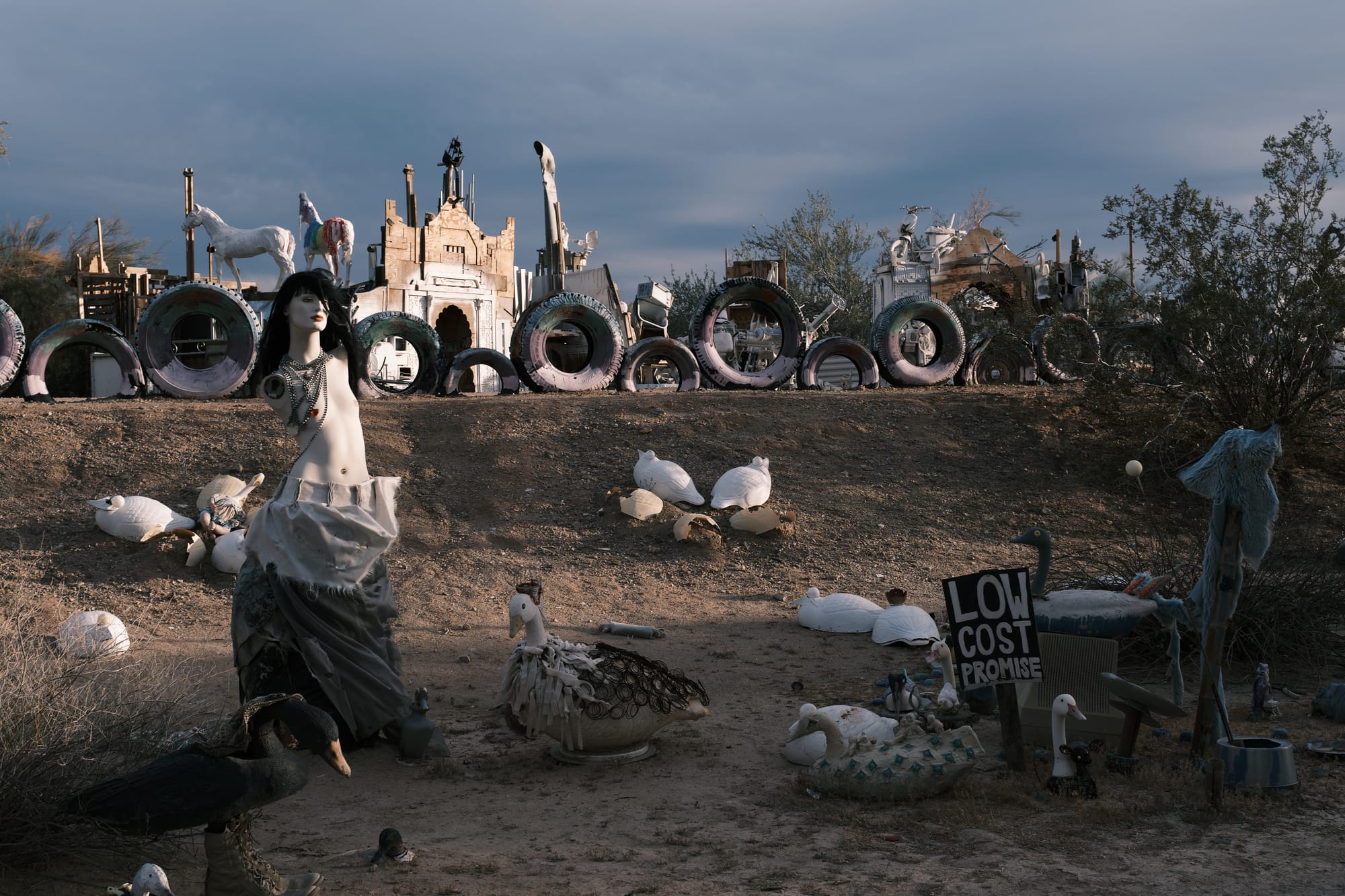
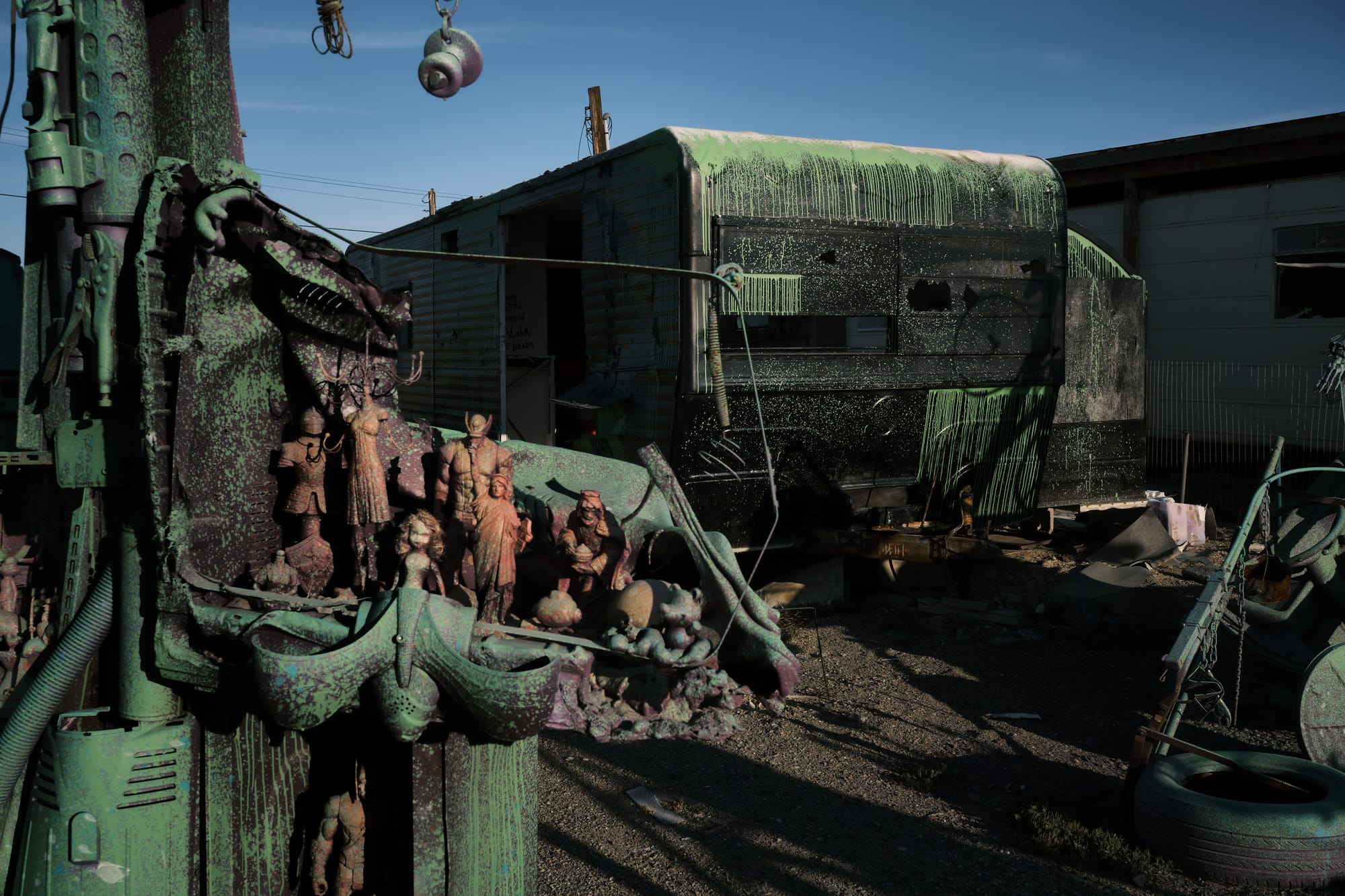
Russell was a tech guy from, surprise, the Bay Area who started doing art at, surprise, Burning Man. He built East Jesus entirely from trash found in the desert – abandoned cars, electronics, the detritus of our Capitalist system. The idea was to take the system’s waste and make meaning out of it. Things break, they are thrown away, art pieces emerge from the wreckage. That was the guiding principle.
Both Salvation Mountain and East Jesus became non-profits after the founders died and acolytes continue their operations. East Jesus is an official museum and is one of the few pieces of land in Slab City that is owned by the resident.

Everything in between, however, is not so spectacular. There’s plenty of salvage punk type art scattered around, but nothing like the big works. And for the most part no one owns anything. People come and take over any empty spaces and make-shift domiciles, then they leave and someone else comes and replaces them.
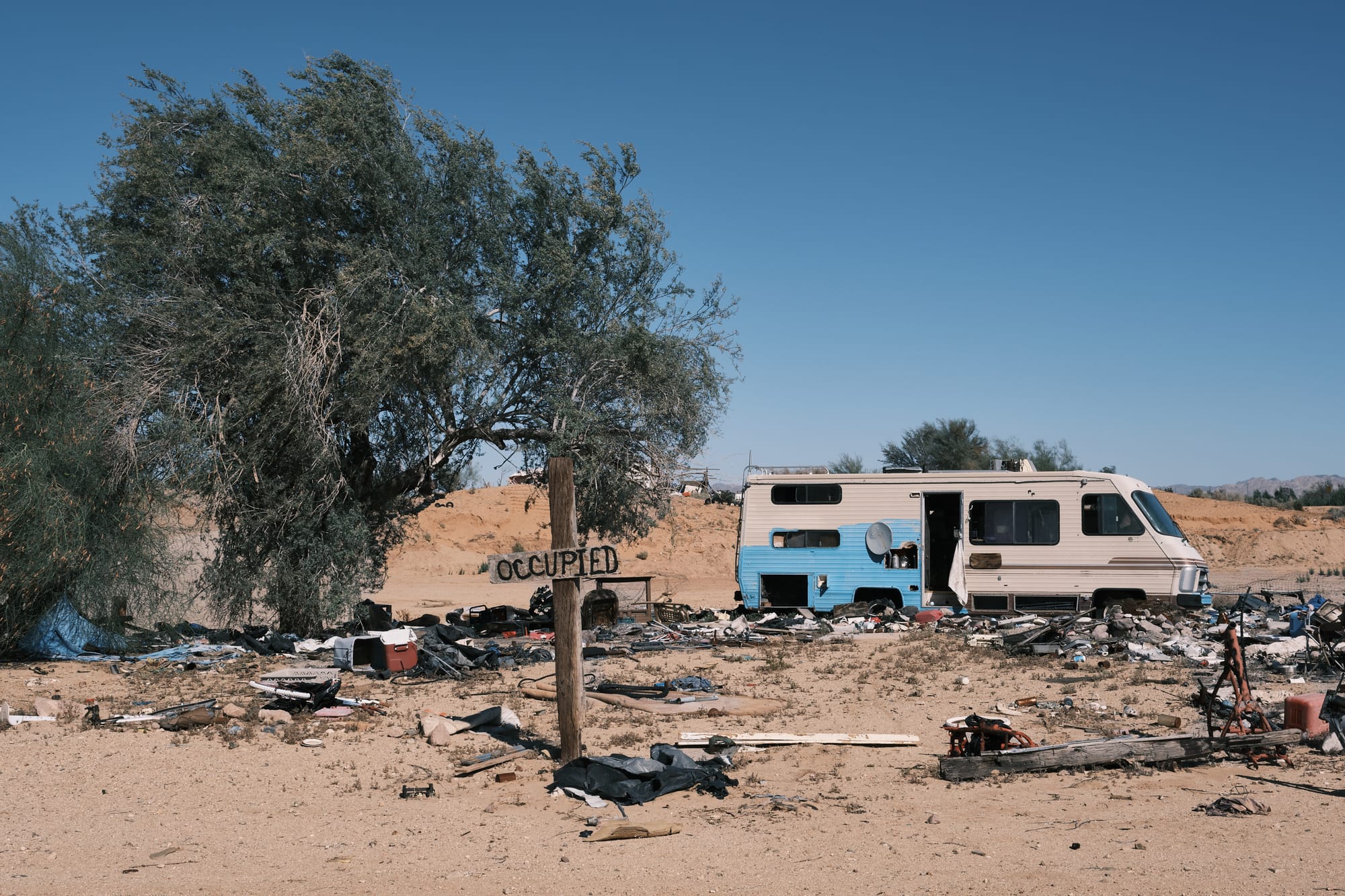
Slab City is definitely not a utopia, but it is an alternative way of arranging society. It is anarchist in the sense that what organization there is grew organically. No one is in charge. Everything pretty much works by consensus. Angry individualist cranks are free to be angry individualist cranks, as long as they don’t hurt anybody. There are stories of bad people who died in mysterious accidents, but compared to back east, or inner city California, it is surprisingly non-violent. Slab City’s informal social structures that formed organically from the bottom up, it appears, work better than regular governments with reams of rules and regulations and top down decision making. One might think that tough law and order policies abet and even create violence. The Slab City reality in that regard is what writers like Le Guin and Graeber would expect.
Bombay Beach
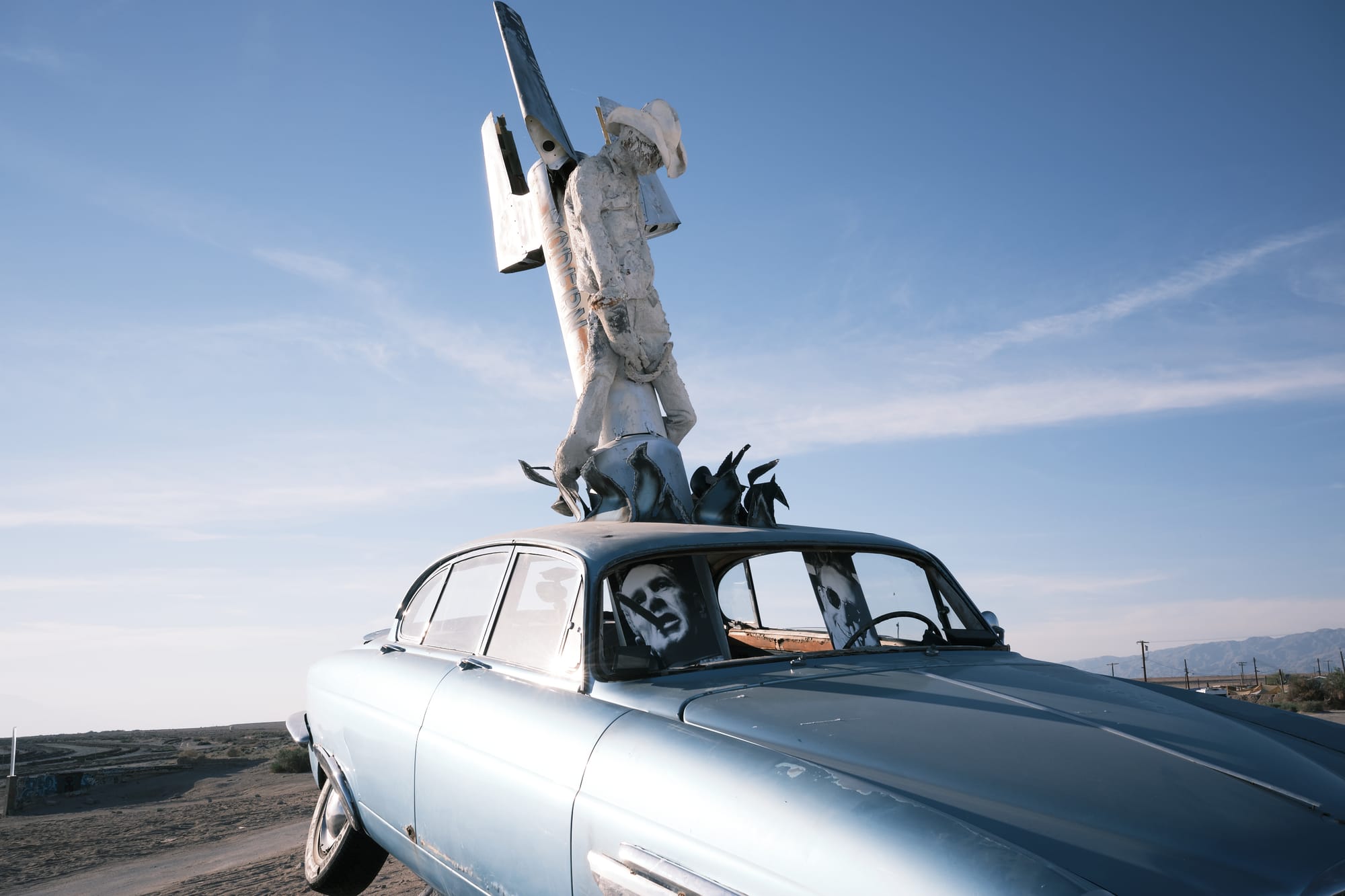
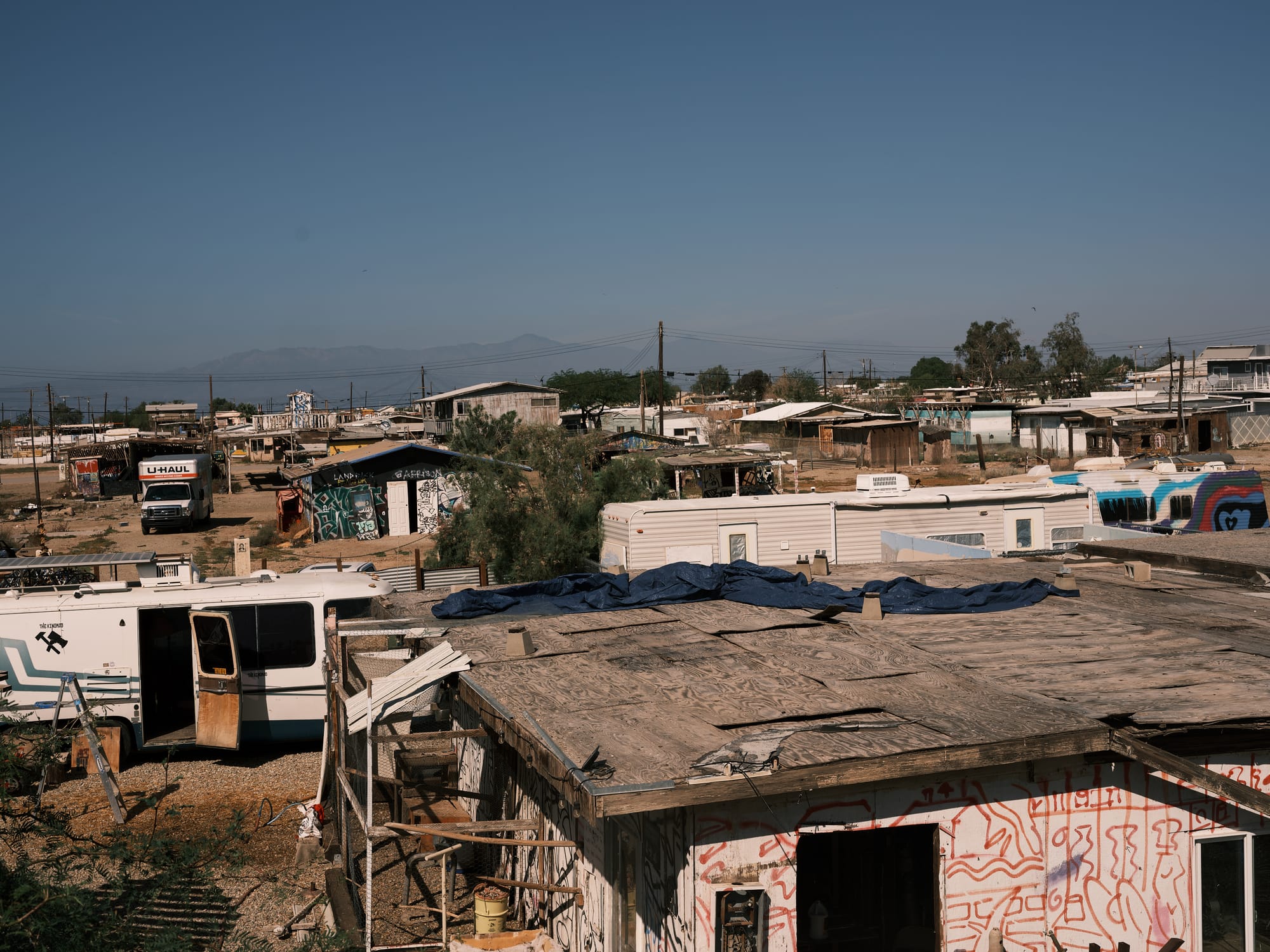
When I left Slab City after my first visit, I wanted to see the Salton Sea and saw a sign that said “Bombay Beach 17.” I had never heard of it before, but 17 miles seemed reasonable so off I went. When I turned off the highway and headed towards the beach I saw several Burning Man type art installations. When I got to the beach, I was surprised to see quite a few sculptures, some pretty large.
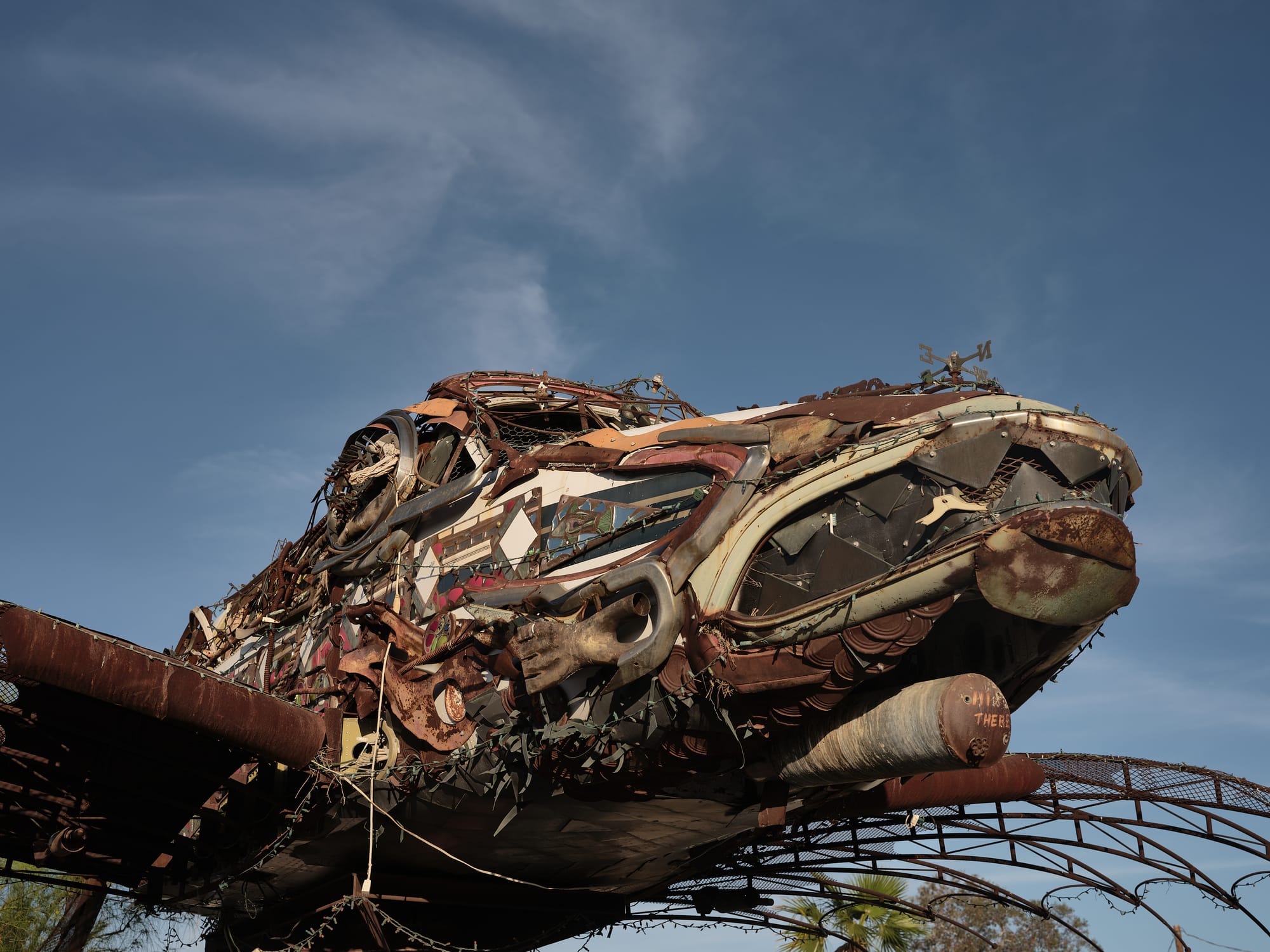
I’ll write a lot more about Burning Man art in a future chapter, and there is no single definition that covers all Burning Man art, but in general it is designed to be impermanent, it will either be destroyed or be removed; it is designed to be shown in a particular place; it is usually interactive, often meant to be touched or climbed upon; it is often made from salvaged industrial materials, the worn out trash of modern civilization; and it’s message is spiritually earnest, completely lacking in irony.
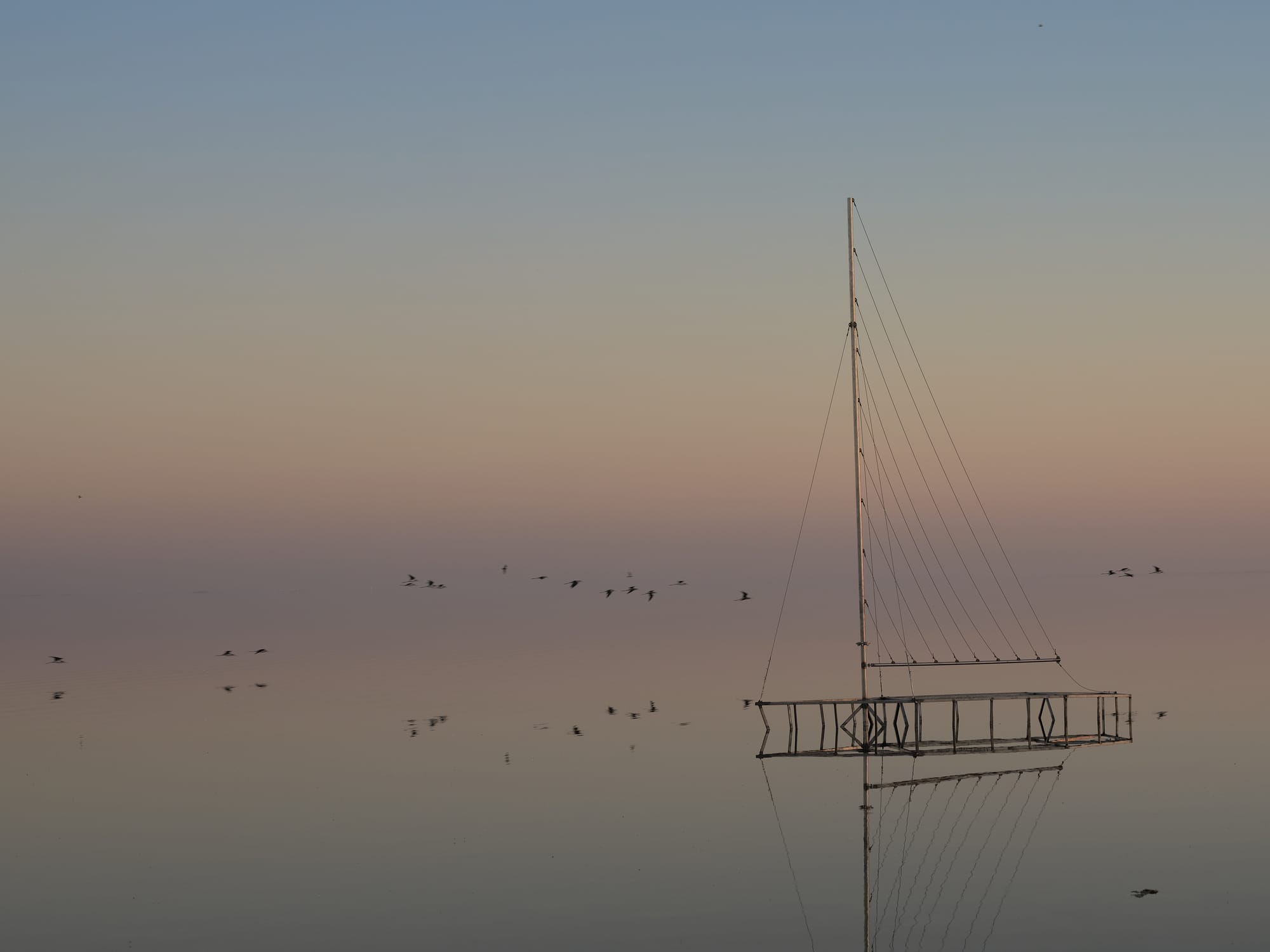
I’ll also have a lot more to say about the Salton Sea, but briefly: Geographically it is in what’s called a sink which is about the same distance below sea level as Death Valley. Over millions of years the Colorado river would periodically change course and fill the sink to create primordial Salton Seas. It was a natural lake as recently as 1700 C.E. and its impermanent nature was alive in the cultural memory of the local Indian tribe, the Cauhilla.
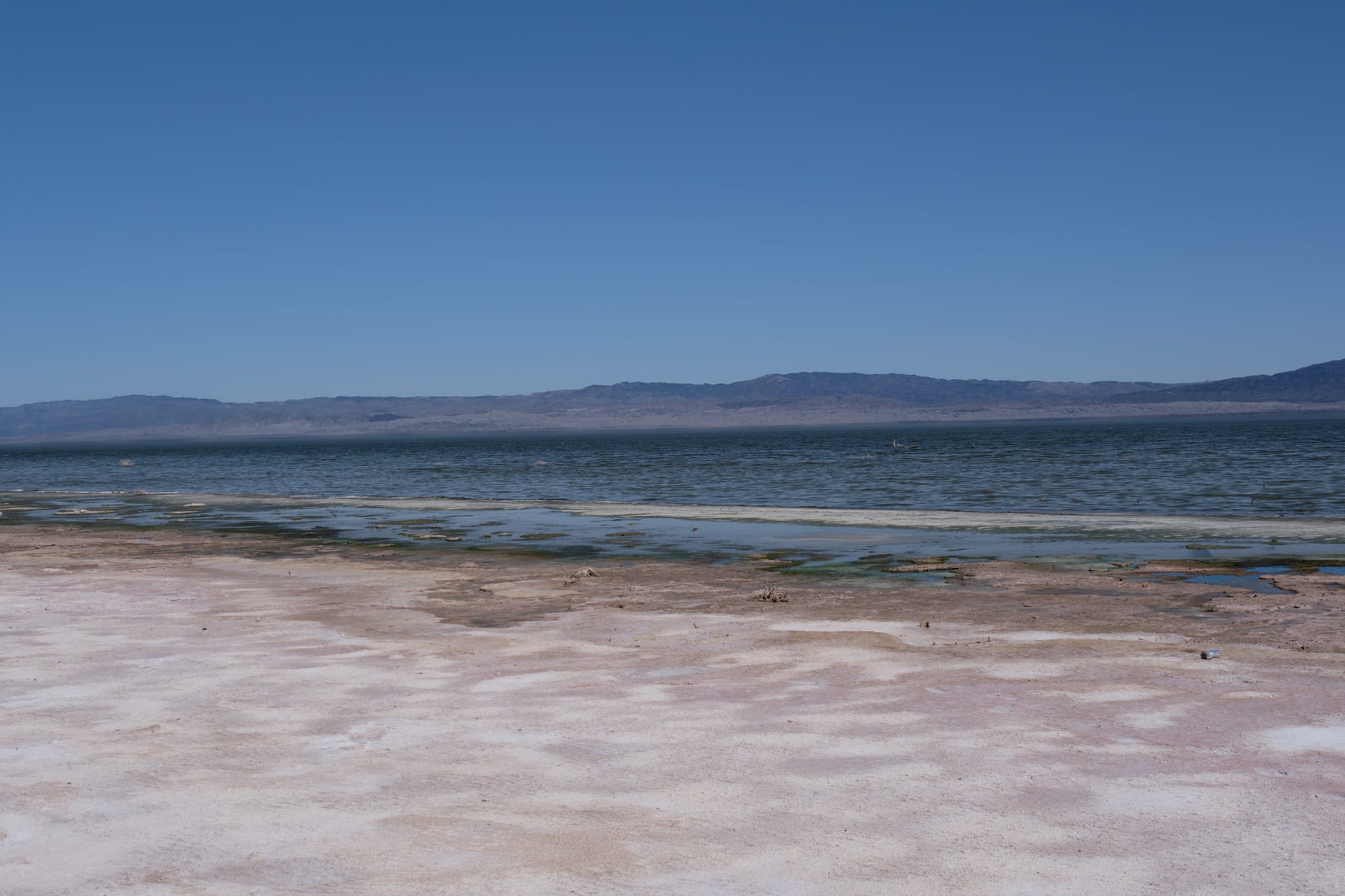
The current Salton Sea was not created as a result of natural processes. It is the result of incompetent humans building canals to redistribute the Colorado and inadvertently causing the Salton sink to flood. Unlike the natural history of filling and evaporating, the dammed Colorado no longer flows through the sink and as it evaporates, the salt, natural toxic chemicals, and toxic farm chemicals leach into the ground. As the water evaporated and the salinity increased, toxic algae blooms killed all but a few of the fish and most of the birds, leaving a hellish stink in their place. During the summer the residents cannot go outside other than to their cars and back. When it’s dry and the wind blows, which is often, the chemicals in the exposed lakebed take to the wind and blow the toxic dust as far away as the California coast leaving a swathe of respiratory problems in its wake. Children and the elderly suffer most.
Before the fish died, the Salton Sea had a heyday with world-class fishing and yacht clubs and frequent visits by Hollywood stars like Frank Sinatra and Jerry Lewis. Developers moved in to selling get rich quick schemes in what would be the new Palm Springs, only with a lot of water. But without the constant flow of new water from the Colorado, the sea receded, it became ever more salty, the fish died, and it began stink. The Hollywood stars and tourists moved on to the next shiny new thing. Those who bought property were hung out to dry.
We could consider the Salton Sea’s heyday as something of a Capitalist utopian experiment. Seen that way, the results would seem to indicate that unfettered Capitalism destroys the environment and significantly worsens the lives of most people who live in it. Of course it wasn’t a utopian experiment, it was just sold that way. Like so much of what passes for Capitalism, the boom at the Salton Sea was a scam built on a mirage. It worked just as advertised for a short while, then collapsed under the weight of its fictions.
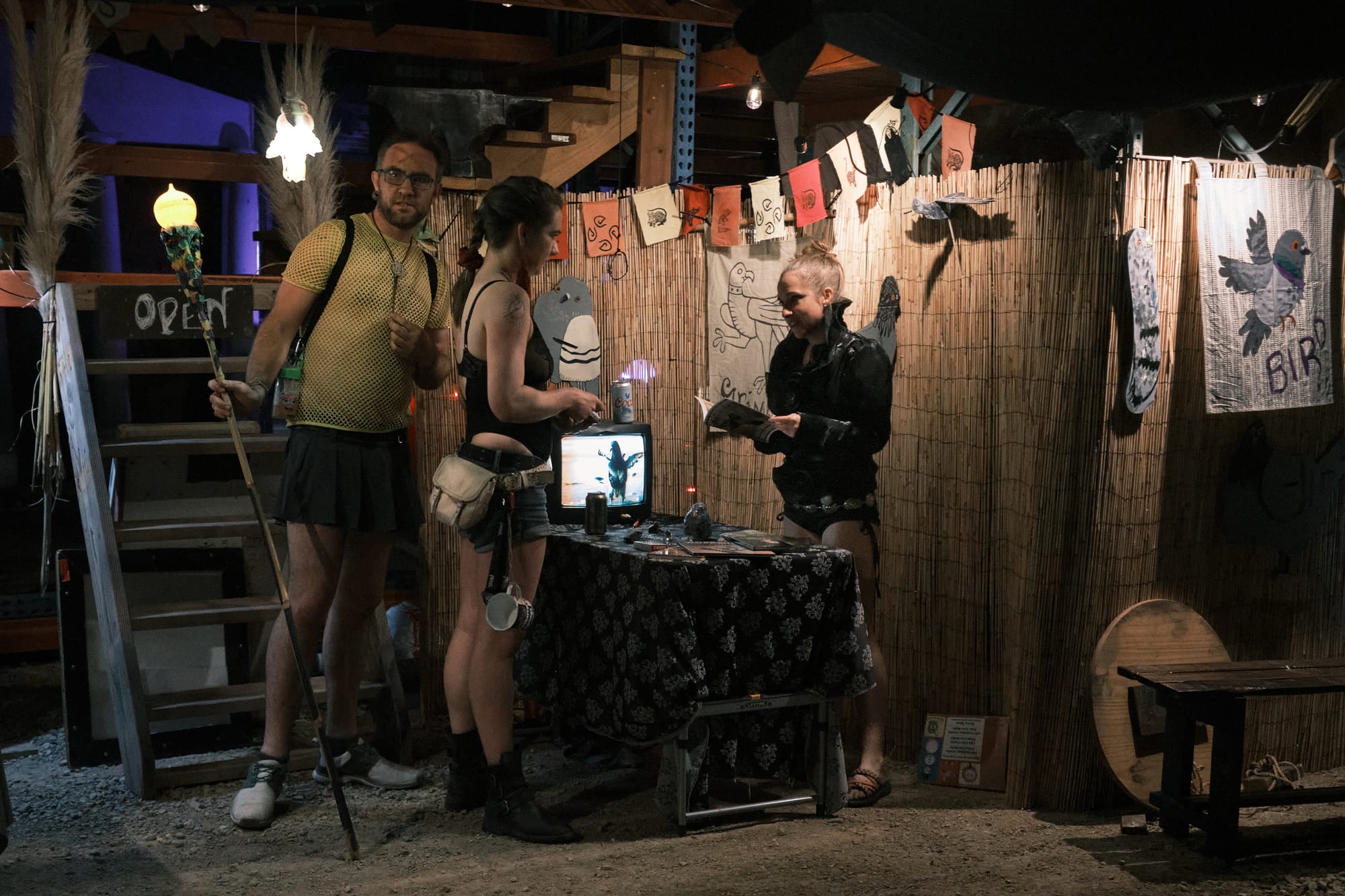
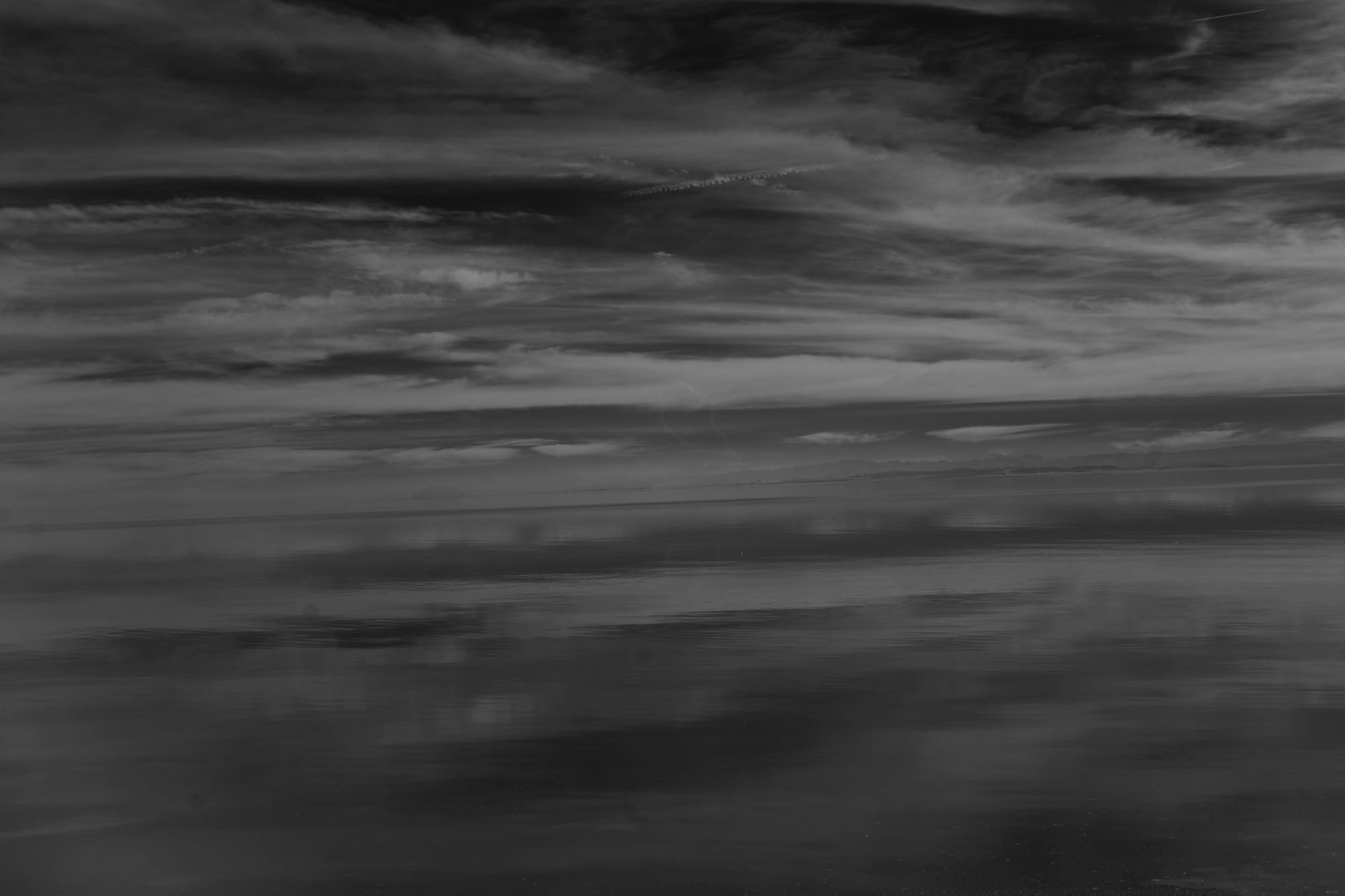
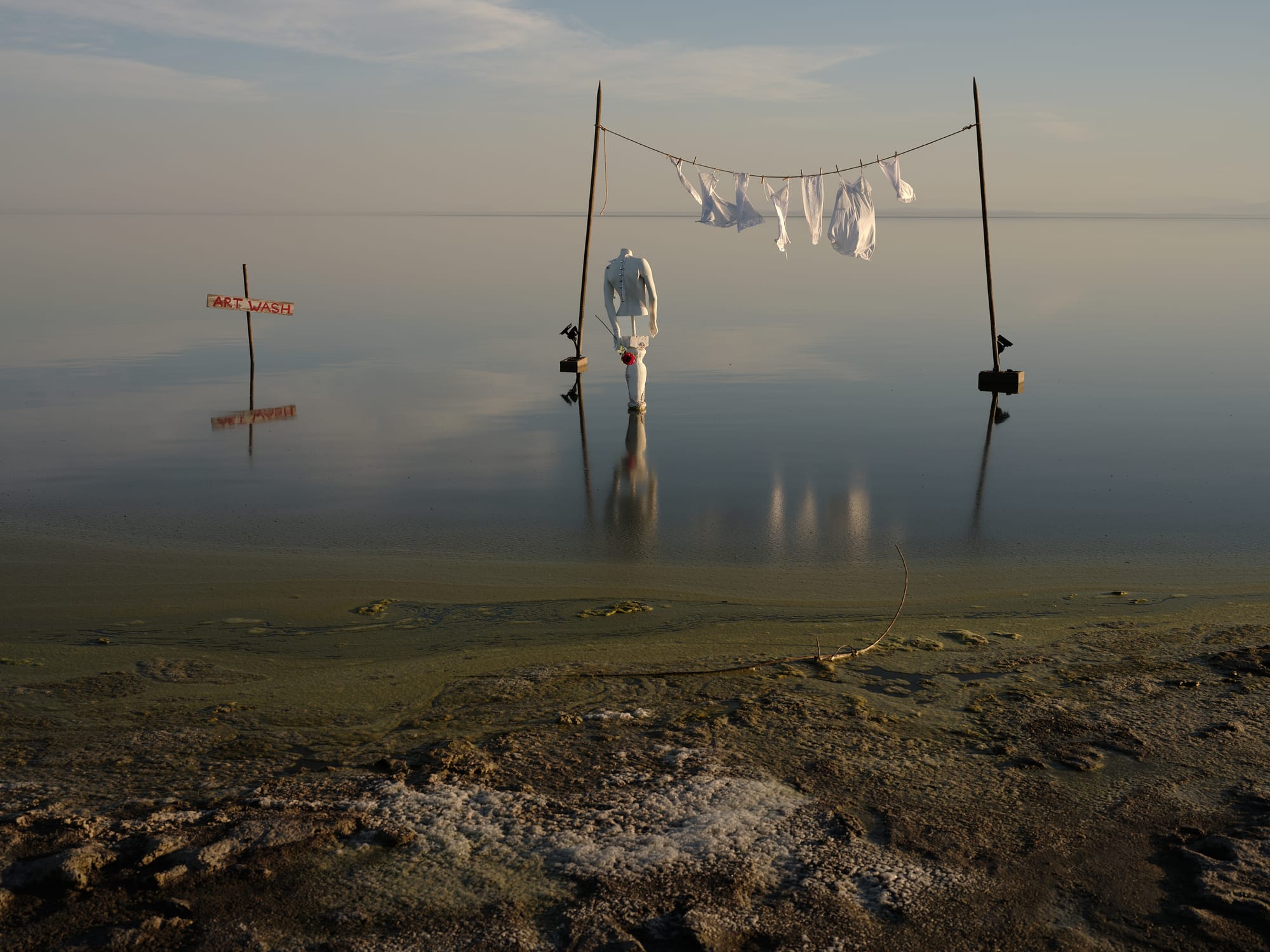
Of course I didn’t know any of that when I pulled off the highway. It was late afternoon, approaching golden hour, and the light was incredible. I don’t know if I’ve ever seen a light so beautiful as the late afternoon light at the Salton Sea. The inhospitable desert environment that receives less rainfall than the Atacama. The utter barrenness of the sea, sky, and land surrounding it. Perhaps it’s the chemical-laden dust in the air that gives the light its special quality. Whatever the reason, that beautiful light filtering over a dead dark sea and its salt white beaches only a couple hours from L.A. is like bait set out for artists, thinkers, and ruin porn enthusiasts.
A guy named Tao Ruspoli happened by one day and took the bait. Ruspoli is the son of an Italian prince and Austrian-American actress who was born in Bangkok and raised between Rome and Los Angeles. He’s an accomplished documentary filmmaker who ran an LA filmmakers' collective out of a converted school bus in Venice Beach. He’s been practicing nomadic, bohemian, community-based art since at least his 20’s. He had been prepped for his fate with Bombay Beach by Hubert Dreyfus, the legendary philosophy professor at Cal Berkely. Dreyfus taught that meaning emerges from engagement with place. He argued that a place isn’t primarily something we have beliefs about, it is a physical and cultural thing that we move through and interact with, something which requires developing skills to make the most of it, or to simply survive. A map of a place doesn’t tell you much of anything about what you need to know to live in a place, it is more likely to be a source of disinformation. Drefus’s idea is that we feel it before we think it.
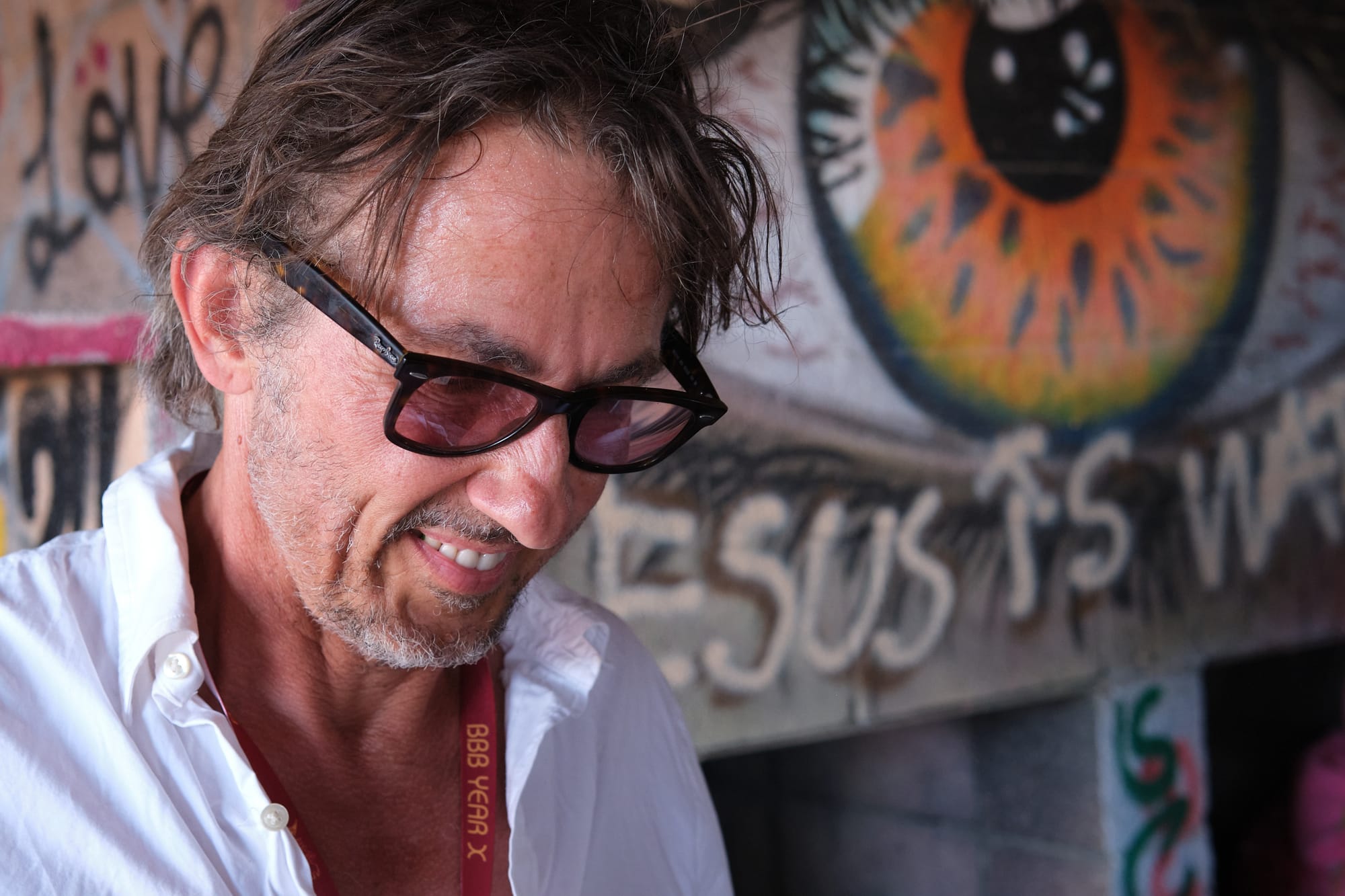
Ruspoli bought some property there and, along Stefan Ashkenazy and Lily Johnson White, founded an annual philosophy conference and art festival called, jokingly, the Bombay Beach Biennale, after the big art show in Venice, Italy. In the 10 years since the first Biennale, a broader art community has sprung up, at least during the winter months. Quite a few artists bought property and live there during the cooler season and there is public art all over town and on the beach.
The Biennale’s founders are each interesting in their own right:
Stefan Ashkenazy bought a rundown hotel in West Hollywood in 2004 and transformed it into the Petit Ermitage, which is described as a refuge for Bohemians, artists, and bonvivants. It has art by Miro, de Kooning, Dali, among other notables, and a saltwater pool and a butterfly sanctuary. It sounds like an LA version of the old Chelsea Hotel, only very well-furnished and for really rich people. He’s also been very involved in Burning Man, running a camp called Cirque Gitane, and started a nomadic traveling circus. He reportedly owns significant property in Bombay Beach and is developing something called The Last Resort, which is supposed to be the worst hotel in the world. He does a posh fundraiser for the Biennale every year at the petit Ermitage.
Lily Johnson White is an heiress, a member of the Johnson and Johnson family with a degree in art history and photography.
The founders’ bios remind me of New Harmony, the home of utopian efforts in southern Indiana which I mentioned earlier, though not the utopian experiments the town is known for - the Rappites or that of Robert Owen, but the effort that began in the 1960’s by Jane Baffer Owen, the heiress to the Texaco fortune who married one of the original Owen's descendants. She turned the town into her own personal art project and brought in intellectuals for conferences and residencies. Philip Johnson and Robert Meier have architecturally significant buildings there, and the Owen properties are full of high level paintings and sculptures. Paul Tillich is buried there. A lot of artists, musicians, and generally cultured people have moved there and there are always concerts, theatre, and other events going on, similar to Bombay Beach, albeit more permanent.
People like to criticize when wealthy people take over poor small towns with their art and high society, but compare that to what the town would have been without them. New Harmony was a sundown town before Jane Owen arrived, backward and racist even for that backward and racist part of the country. And think of the other ways she could have spent that money. Like today’s billionaires, she could have built a space ship or some other sort of golden calf and dedicated her life to ignoring or destroying the world in one manner or another.
Same thing with the rich folk funding the Biennale. Bombay Beach before them was no paradise. The world, and Bombay Beach, is better for their efforts.
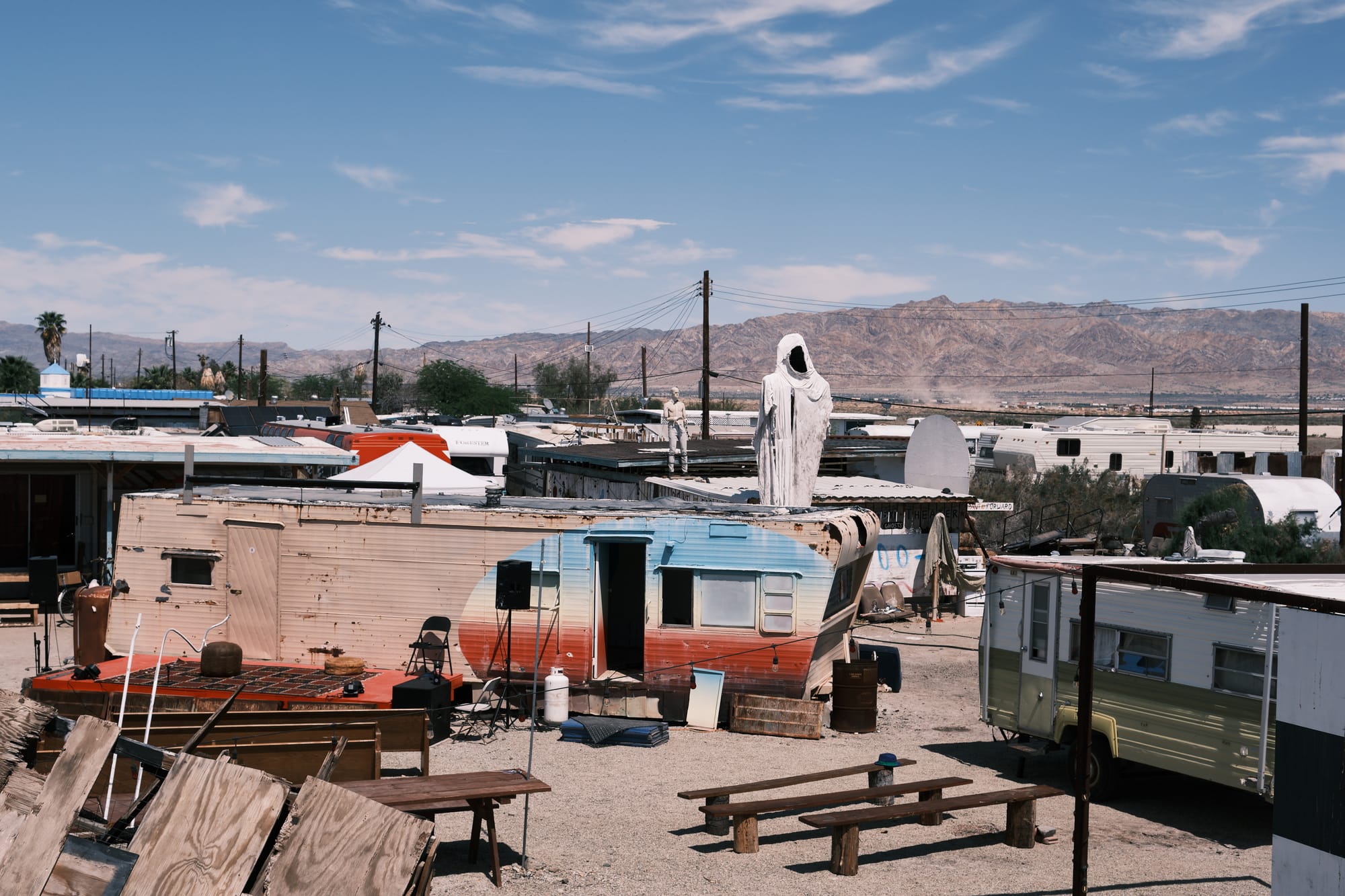
But it's not great. Bombay Beach has a population of around 250 and declining. The poverty rate is 61 percent and the median household income $26,000. The median age is 54. Demographically it is majority white, but just barely at 53 percent. There’s a 26 percent black population and 20 percent two or more races, non-Hispanic. Most of the people who remain are stuck there with no savings and unable to sell their homes for more than pennies on the dollar, or not nearly enough to move anywhere, else.
I met a local with swastika tattoos and the town kids that were hired to hand out information verbally attacked some black visitors calling them niggers. Bringing educated decent people into the town cannot make it any worse, and possibly much better. I don’t think there should be super rich folk, government should handle these things, but since there are wealthy individuals and the government doesn't do much, it’s great when the rich try to make the world a better place through art and philosophy.
The Bombay Beach Biennale might seem like a mini-Burning Man at first glance, and they have a lot in common. The Biennale is likewise an art festival dropped into a strange, desert location. It's a temporary community in a physically challenging apocalyptic looking place. As the irony of the name “Biennale” suggests, it’s also something of an attack on the international art world. Ruspoli says that part of the festival’s aim is to take the art world down a notch and take Bombay Beach up a notch. Lily Johnson described it as a place where artists could work freely outside the commercial art world. Again, much like Burning Man. And like Burning Man, the art is mostly earnest, as in the opposite of ironic, which is pretty much the opposite of what flys in the international art world.
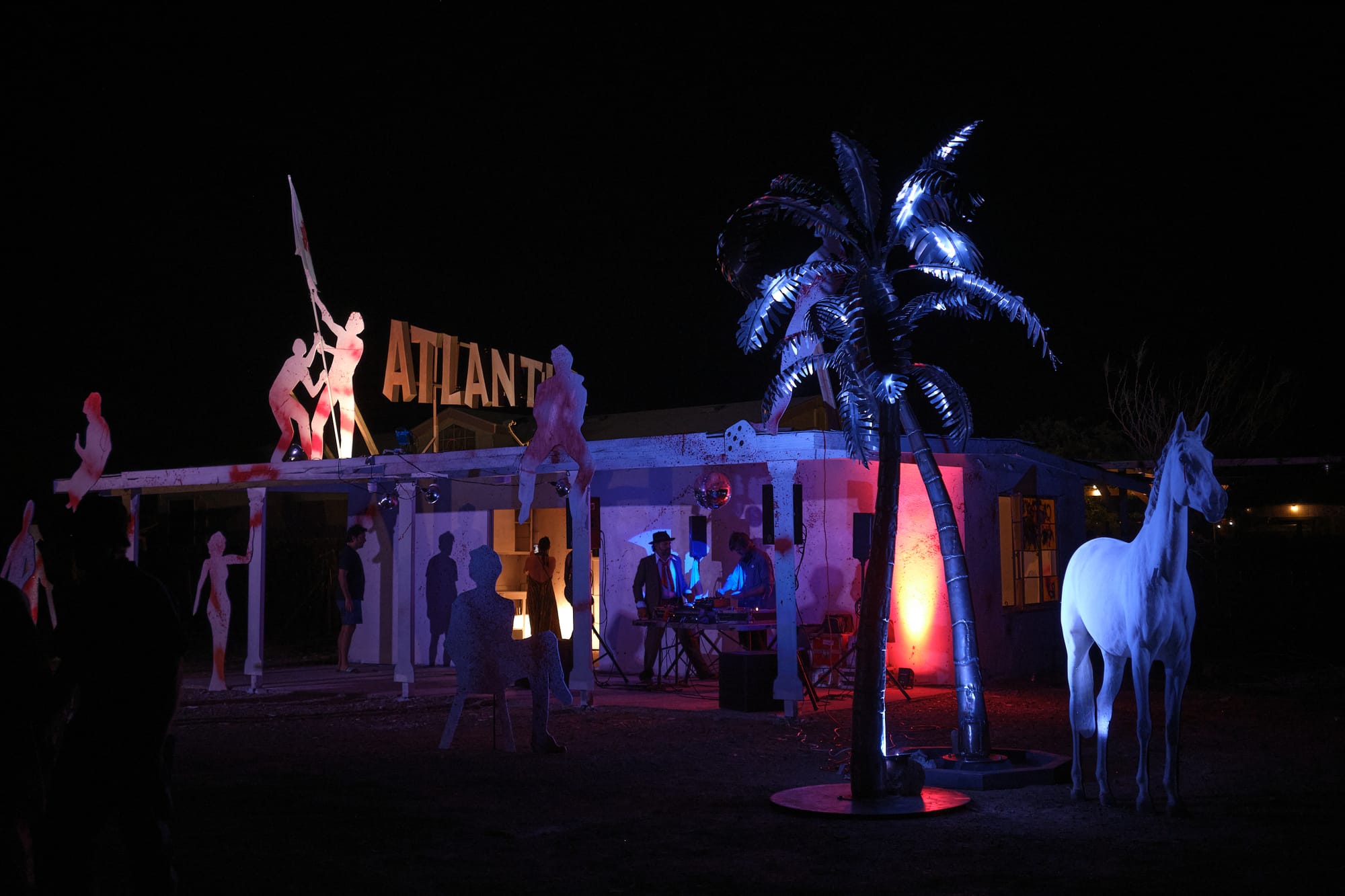
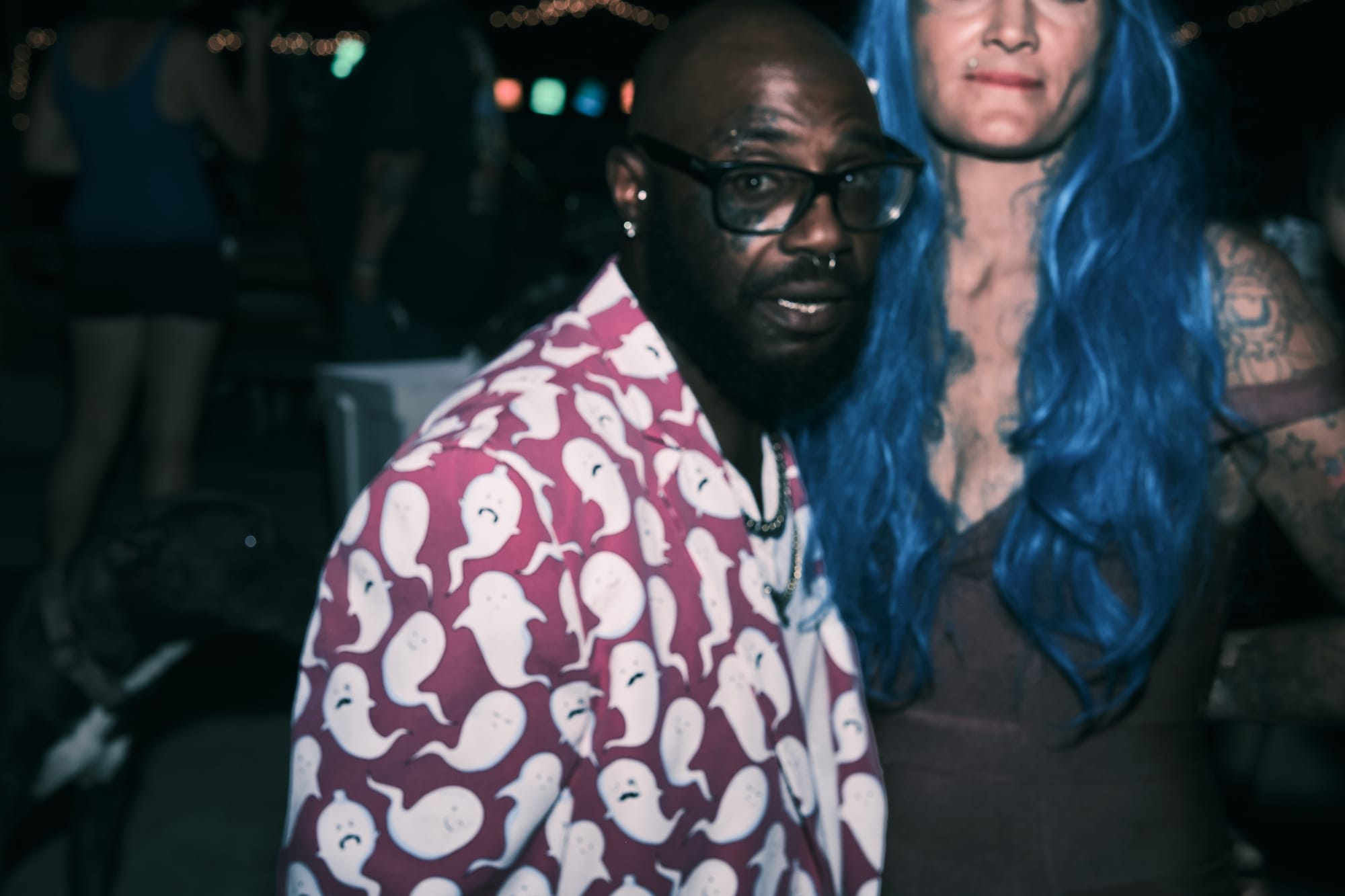
The Biennale also has a party scene, though nowhere near as robust. Pretty young women and men go round and round from art installation to club to party all dressed up in edgy, often sexy costumes. Middle-aged executive suite types throw aside their expensive suits to go incognito and “be themselves.” They wear kilts like they think they are Mel Gibson, or other ridiculous Mad Max get-up and walk around either extremely drunk and full of themselves or slink around the margins self-consciously. And there are plenty of snooty tech bro types constantly looking over their shoulders.
Just about everyone I met in Bombay Beach had been to Burning Man. And of course engagement with the Black Rock Desert is a big part of Burning Man as the Salton Sea is integral to the Biennale, and there are plenty of intellectual events going on there, so it’s not as different as the organizers like to think.
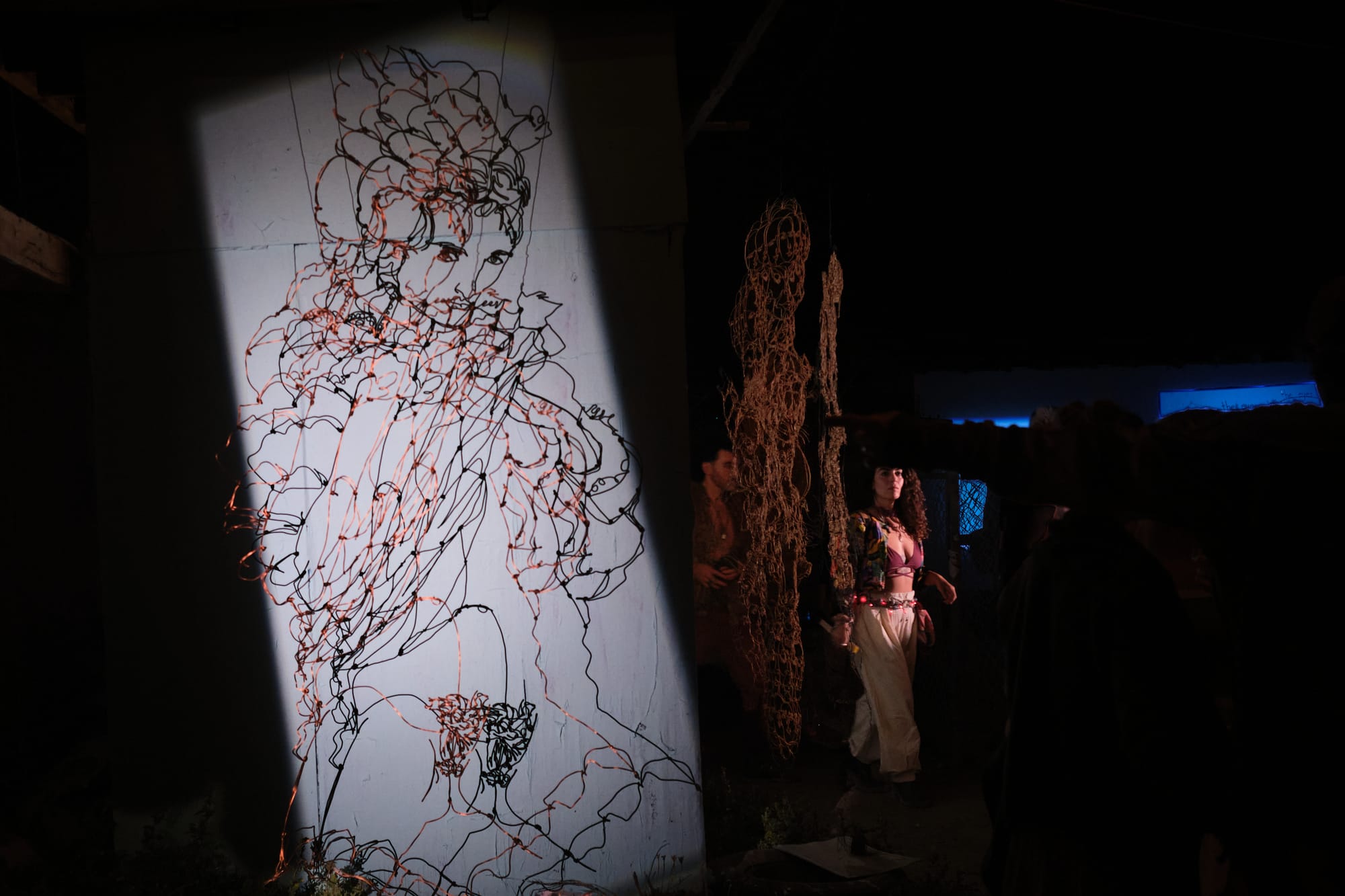
The biggest difference beyond the centering and specific bent of the philosophy conference is that the Biennale is free and open to the public and that the Bombay Beach organizers do not want a big crowd of partygoers. The date for the Biennale is never announced. Knowledge about when it’s going to happen only travels by word-of-mouth to limit it as much as possible to people who know each other. It goes back to Dreyfus’s ideas about place. Unlike Burning Man, the organizers do not want a large crowd of party people who don’t care about the place and do everything they can to avoid engaging with it. They also bristle at the idea of aesthetic tourists enjoying the place as ruin porn at the expense of all the deeper, Dreyfusian layers.
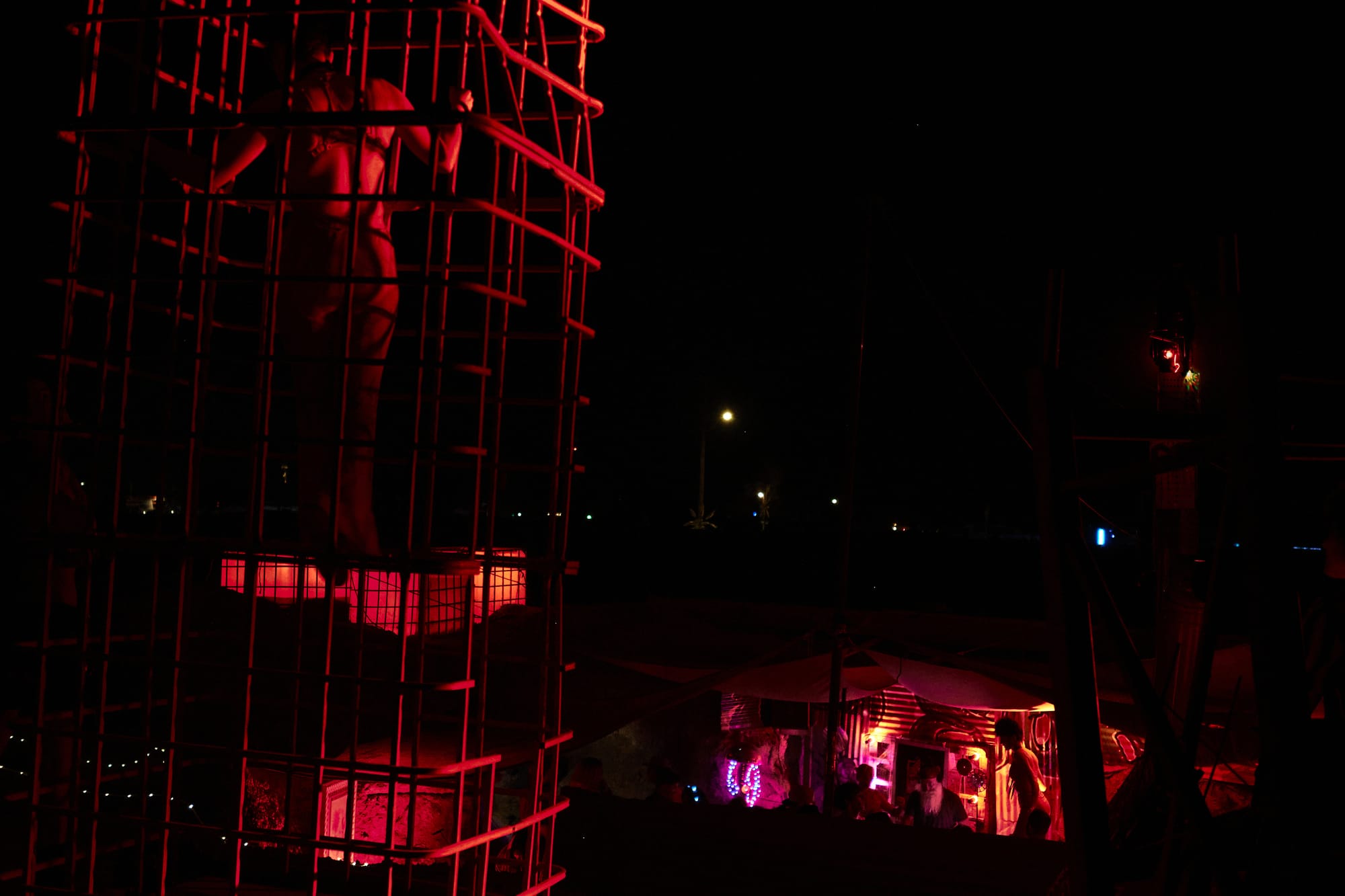
Yet most people seemed to be there for the party and the ruin porn. I guess there’s nothing that can be done to stop it short of closing it off to the general public, which would negate one of the festival’s first principles, which is that everything should be free and open to the public.
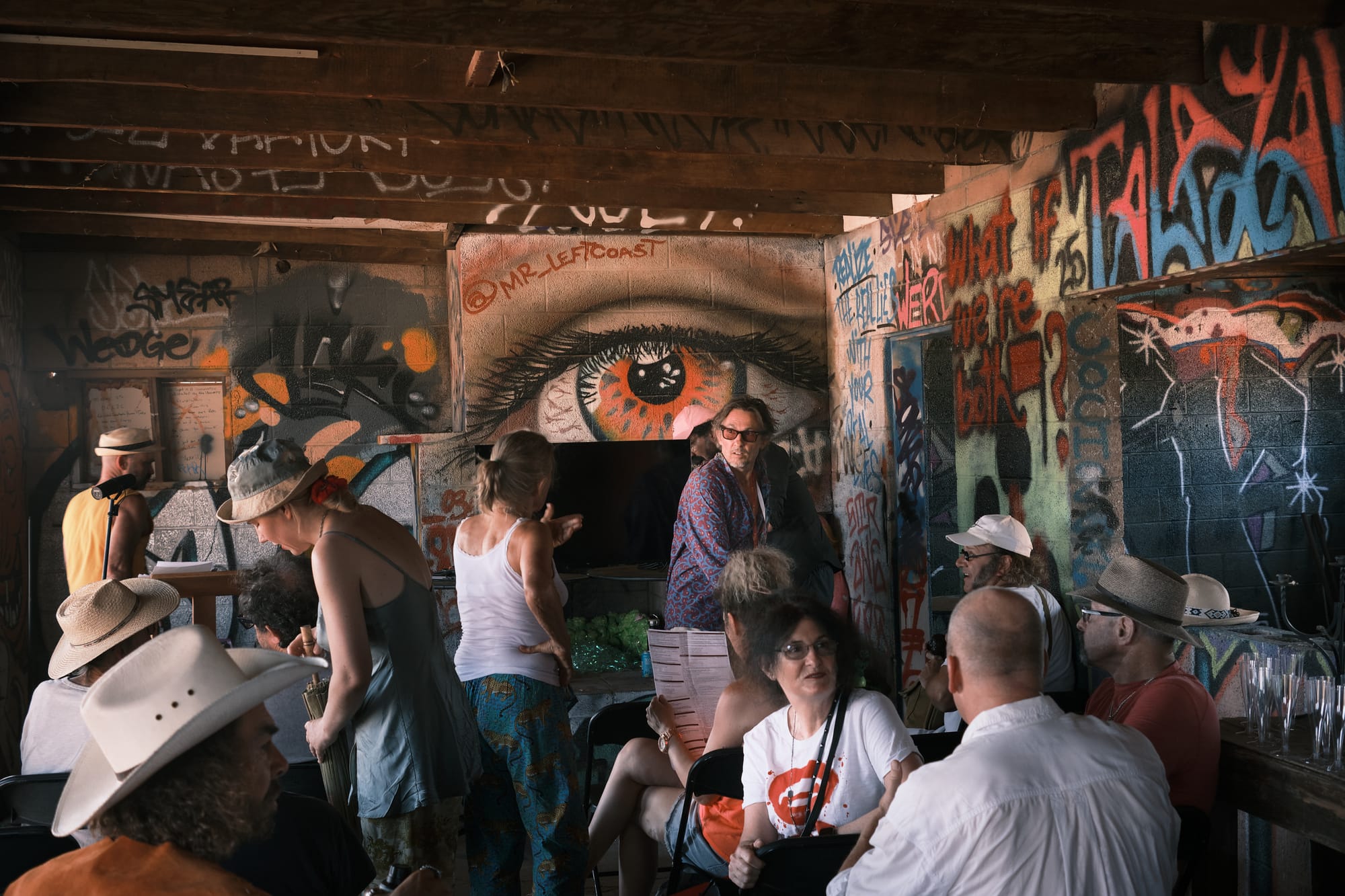
I attended as many lectures as I could and found them fascinating. The speakers were accomplished in different fields and generally gave informative, entertaining performances.
Speakers included the neuroscientist Patrick House, Mehammed Amadeus Mack, Rina Nicolae, Eric Kaplan, and Mark Wrathall, among others. There were also numerous art talks, and fiction and poetry readings. People may talk philosophy at Burning Man, but it is not the core of the experience.
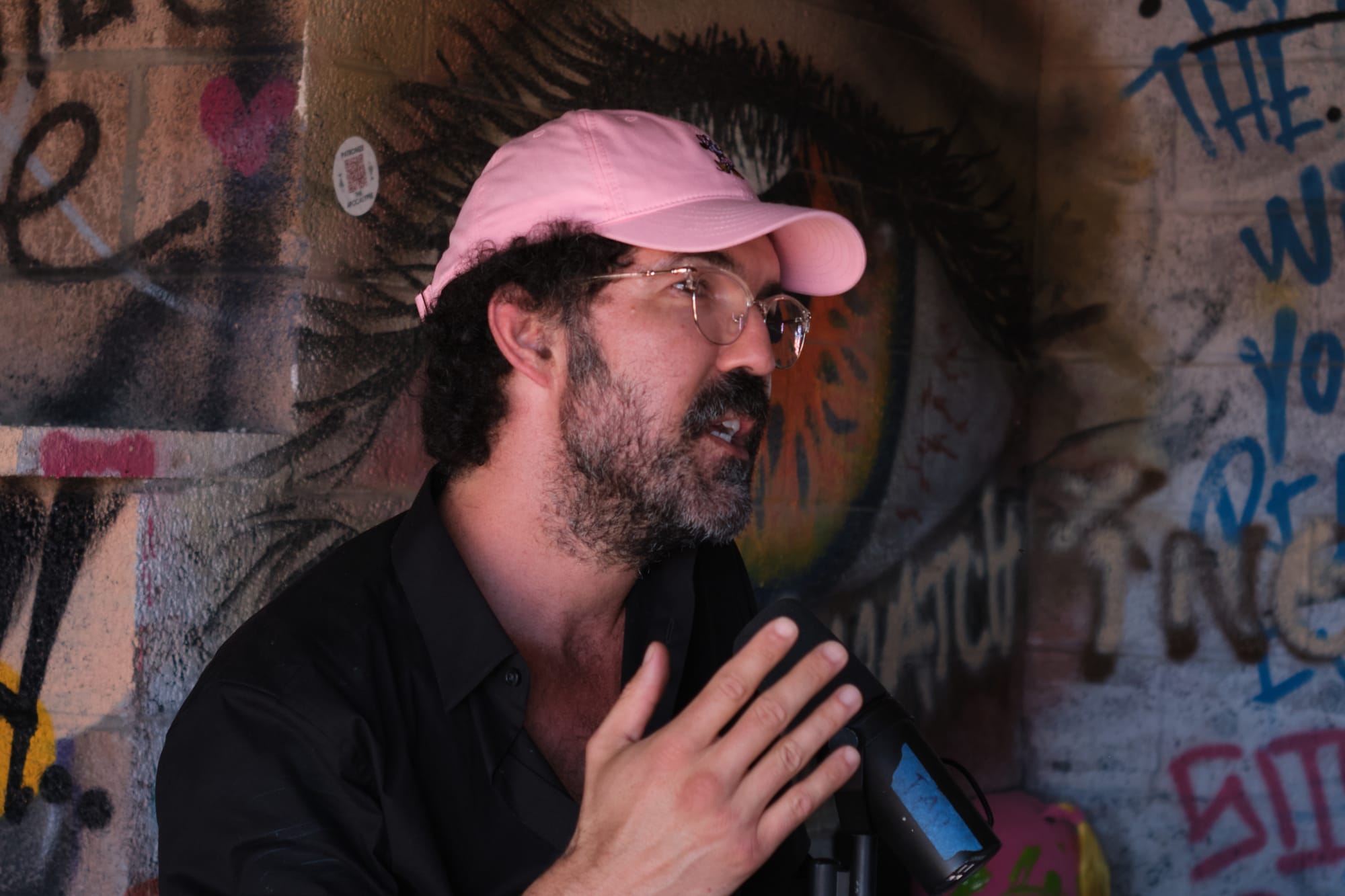
Dreyfus acolytes and the Cal Berkely philosophy department were heavily represented, but not everyone was from that school of thought. There were talks from postcolonial, postmodern and even post human philosophical perspectives. I know many of the speakers were friends of Ruspoli, and at least a few were chosen by Dulcinée Deguere, whose title is Systems Architect, which apparently means the person who is responsible for making everything work. It wouldn’t surprise me if all of the speakers were friends or acquaintances of the festival’s inner circle. I think that’s a good thing. They are interesting, well-educated people and they know a lot of interesting well-educated people. They don’t all think the same things, but it’s probably fair to say they largely share a world view. It’s probably fair to say that I, and most likely you, largely share that world view as well. It’s a good one, but we always have to remember, it’s not the only one, and there are plenty of places where holes can be poked in it, and there are other world views that are better than ours in some ways.
I did not go to Bombay Beach or attend the Biennale for the 95 project, nor did I go to photograph or write about it, though ultimately I made the connection to the road through the Salton Sea. I went as a tourist, for my own enjoyment, because I liked the art and the artists. And on that level, I very much enjoyed the Biennale. I’ve been many years in a cultural and artistic wilderness and suddenly being around all the art and artists and thinkers and generally well-educated people felt like coming home.
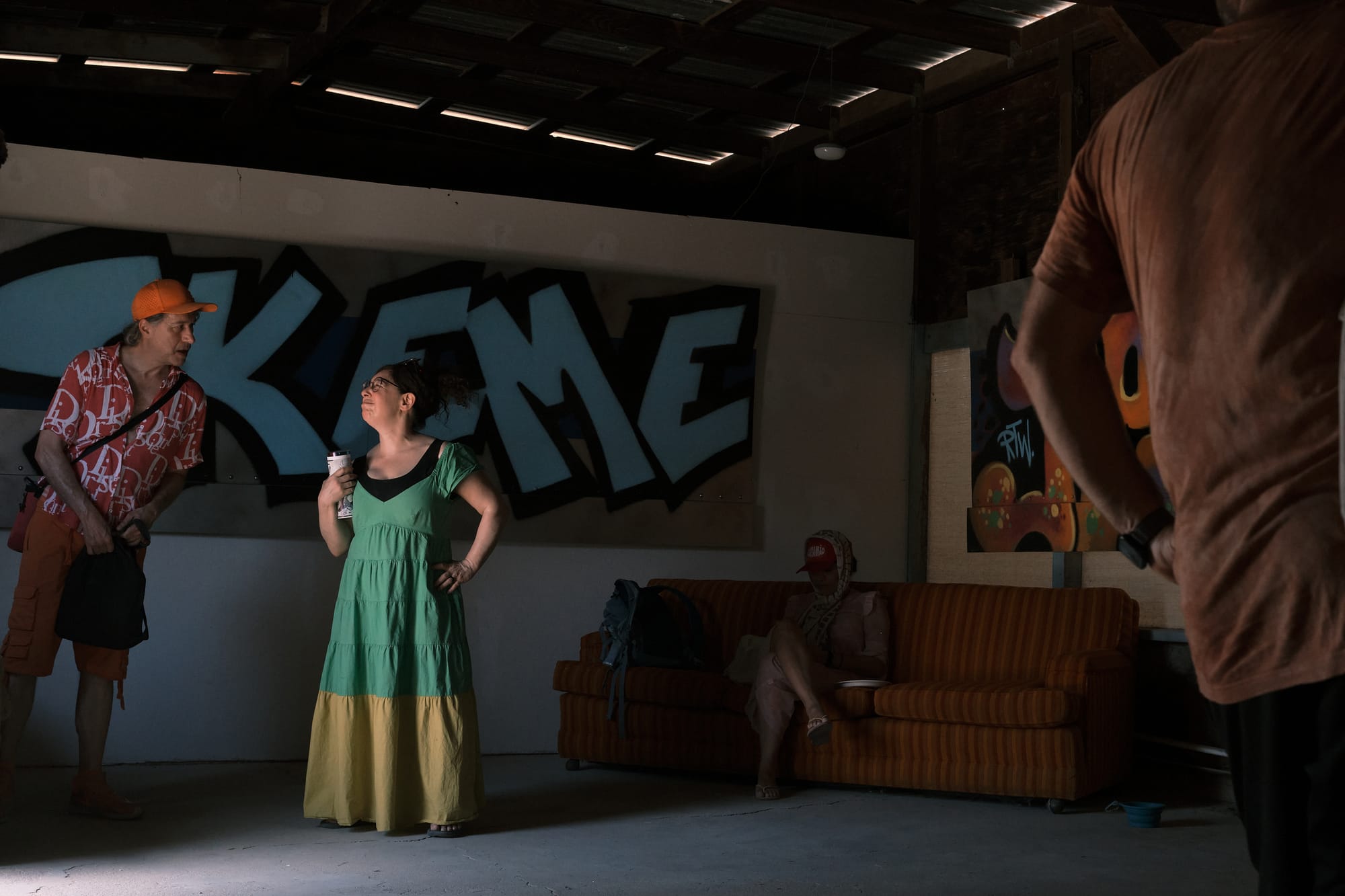
In the gallery with the subway car graffiti above, a guy tracked down the original taggers from New York in the 80's to recreate their iconic images. He is a working class bloke from England who had been raised by Hells Angels in a life of drugs and violence who said his life had been saved by becoming a graffiti artist. He was chatting with a woman and found out she was a Jewish person from New York. He started yelling "hey, a New York Jew! A real New York Jew! Come out and meet her." Of course the poor woman wanted to melt and implored him to stop, but he assured her it was cool, his partner was also a New York Jew and he wanted them to meet. His poor partner came out and tried to calm him down. She assured the woman that he means well but sometimes gets over-excited. They had a brief chat about where they were from in New York to make him feel good.
I relate that because it's kind of how I felt at the philosophy conference, which had a good share of Jewish intellectuals. When I lived in New York about half of my friends, acquaintances and colleagues were Jewish, and generally very well educated. I didn’t much notice their absence in my life until I was back in that milieu at Bombay Beach, and I realized how much I missed them, and the more intellectual, art-appreciating life in general. I'm still in touch through the internet, but it's not the same.
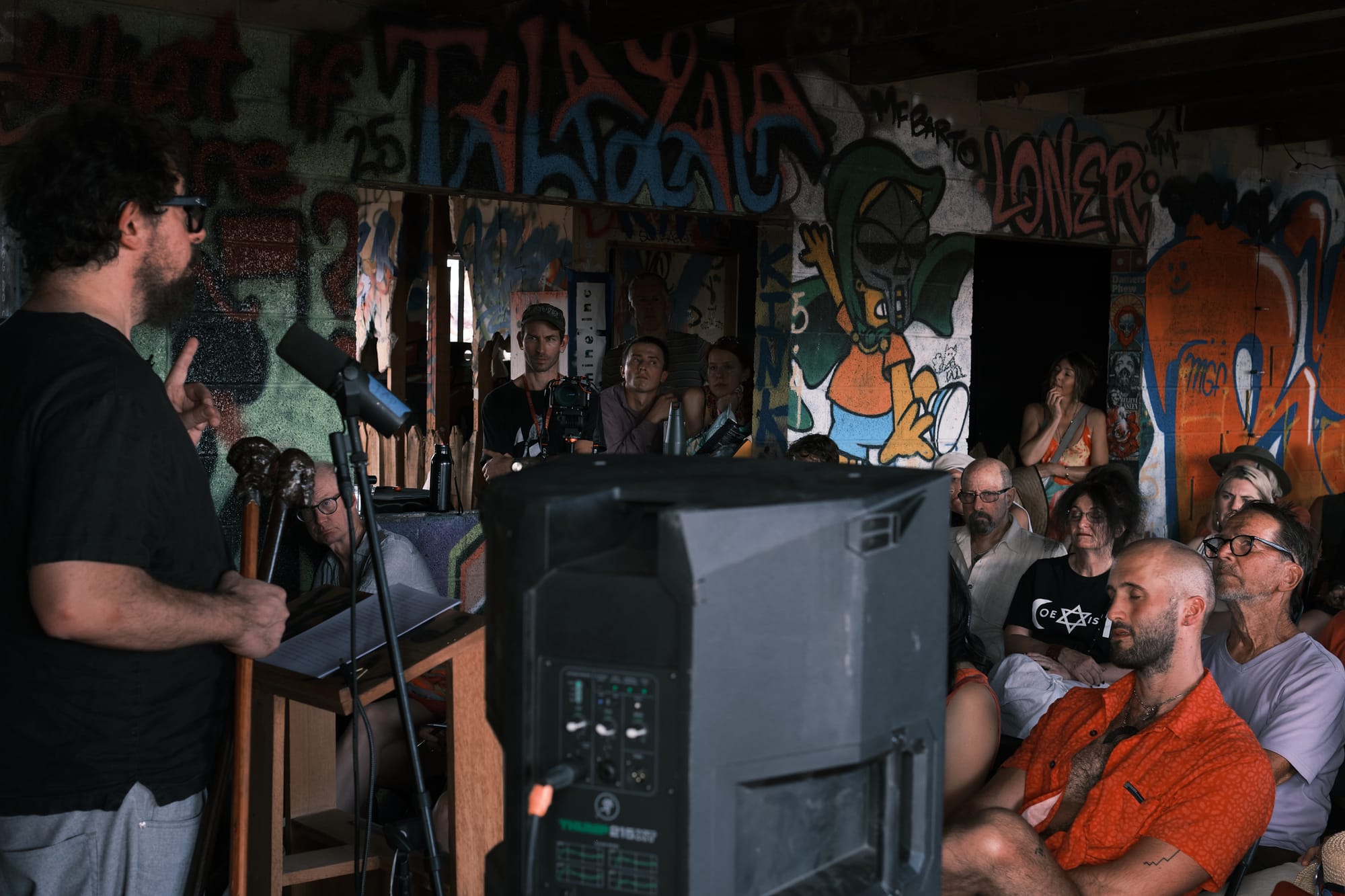
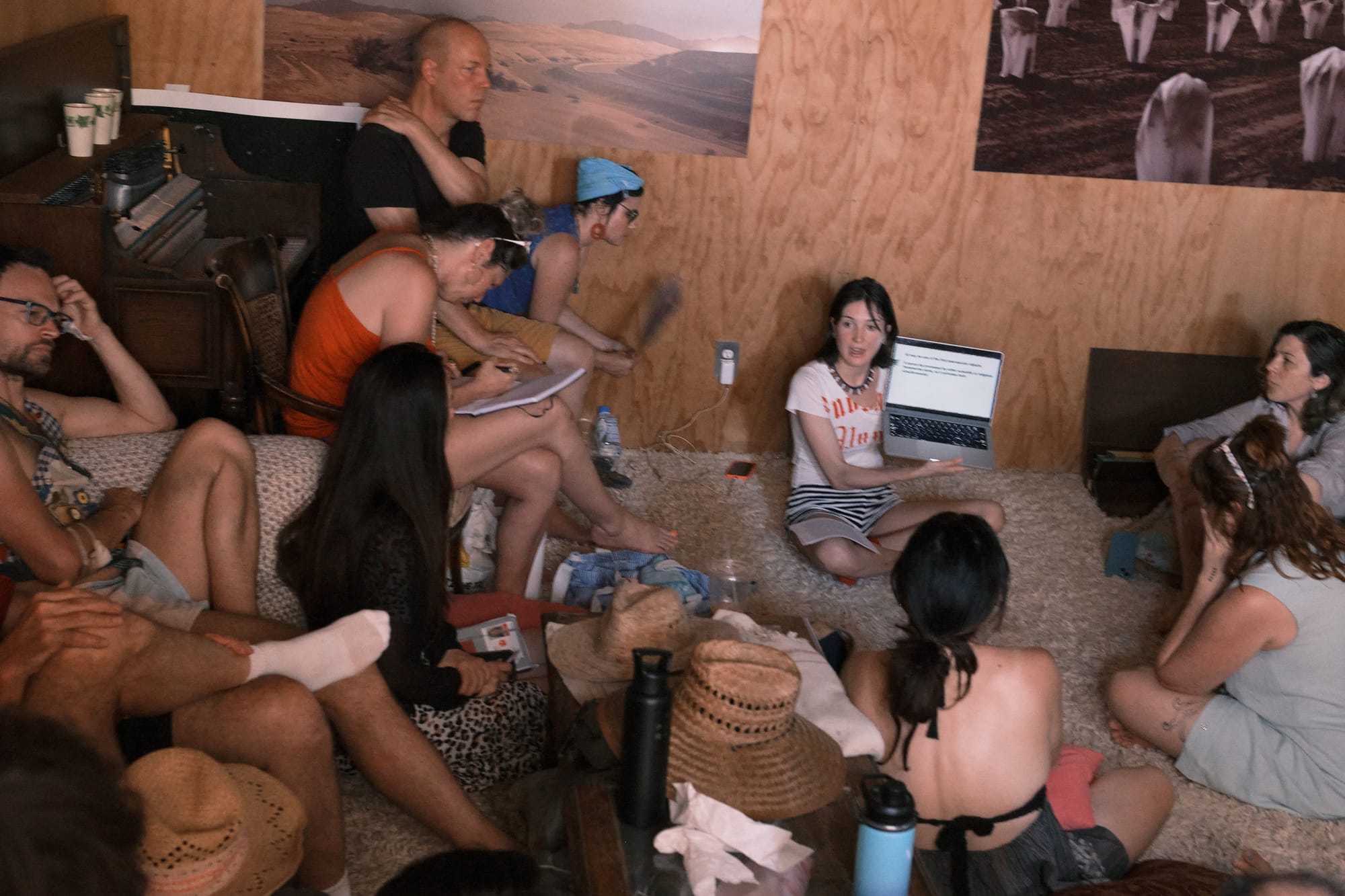
I participated in a writing workshop that was offered, because why not? It was run by Eric Kaplan, a writer for Futurama and Big Bang Theory, among other things. Turns out he threw a lot of references to Bombay Beach and the Berkely philosophy department in Futurama. He is a goofball, but not in the way you would expect given those credentials. He had a harmonium and made us sing a song in some Indian language at the beginning of the class. He was really into Mesoamerican history and the writing assignment was based on the hero twins in the Popol Vuh. He also gave a philosophy talk which went deep into Jewish religious texts that I was too tired and stoned to keep up with. It may have been deep and meaningful, but it was most definitely not funny. In the Q&A someone asked him if he was really a comedy writer. That got a chuckle.
For the writing assignment, he paired us up and assigned each pair a part of the story. I got a young woman who was doing her graduate work at the University of Chicago and her thesis was on the Salton Sea. We worked really well together and came up with a great outline for the project. Then she dropped out, which sucked. I really wanted to learn more from her about her thesis and see what she knew about Graeber and the University of Chicago. I believe he was influential there. At the end there were only a few people left. I think people figured out it wasn’t a serious endeavor, there was next to no feedback on the writing, or that Kaplan was unlikely to offer them a writing job, or maybe they were just busy. We gave a reading on stage to a crowd of three or four people, which was taped and would be played later on the local radio. The whole thing was kind of fiasco. I enjoyed it very much.
One of the people in the class was Janenne Willis, an Australian poet who gave a reading of her upcoming book length poem about the Salton Sea. Fortunately, when I read about it, I missed the part about it being a poetry reading and thought it was a talk about the Salton Sea. Otherwise, I wouldn’t have gone. It turned out to be my favorite thing of the entire Biennale. The poem was divided between three speakers and two other women read with her. It was a passionate, emotionally charged performance, electrifying in stretches. Unfortunately, I had no idea that was coming and neglected to ask if I could take a few photographs. Turned out they would have loved it, but I wasn't going to risk it.
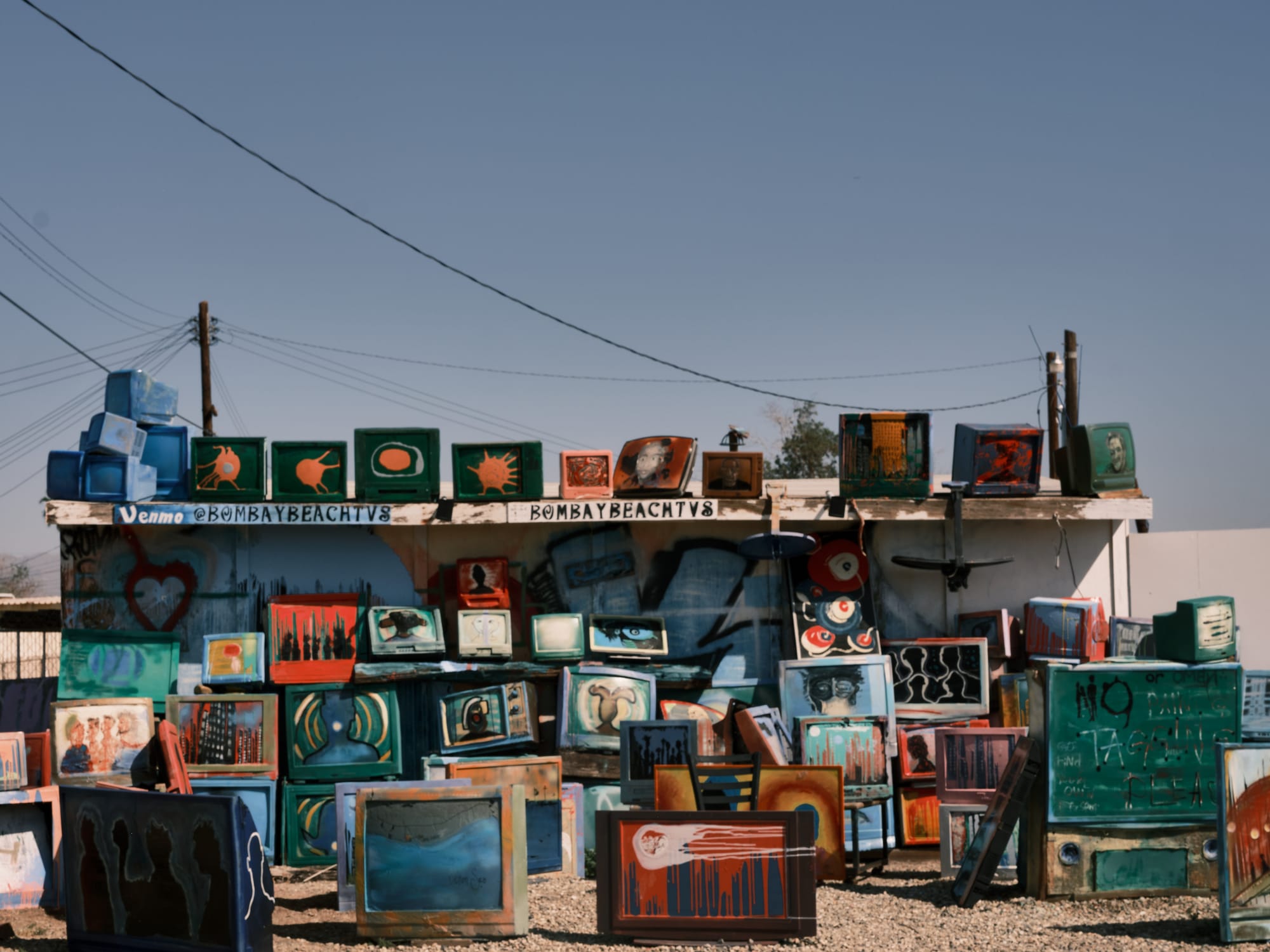
Other than that, I mostly roamed around, checked out the art, and chatted with the artists, speakers, and random people I met.
On the downside, I spent a lot of time in Bombay Beach in the weeks leading up to the Biennale and heard near constant bickering among the artists and dismissive gossip about people who weren’t there at the moment. It’s not exactly utopian, but that’s part of how communities work. Whatcha gonna do, right?
On the group chat, there was a guy that went ballistic when it was announced that the streets would be mostly closed to traffic. He went on and on about his rights, apparently never having experienced streets being closed for a large public event before. The response was 90 percent people trying real hard to soothe him, as those who deal with right wing kooks are taught to do, but then someone would criticize him and he would go on and on for another 20 posts or so. From the start it was clear that nobody was going to stop him from driving into town. There is no government or police force in Bombay Beach, yet he just wouldn’t stop. I think they cut him off at some point because the next day the whole conversation had been deleted. Another example of hopeless male atavism was a guy trying to drive through a large crowd on a street the was closed for a concert, and yelling at people for not getting out of his way fast enough. People basically just ignored him, which I guess is another example of the positive vibe at these art festivals. Most places that would have resulted in a confrontation.
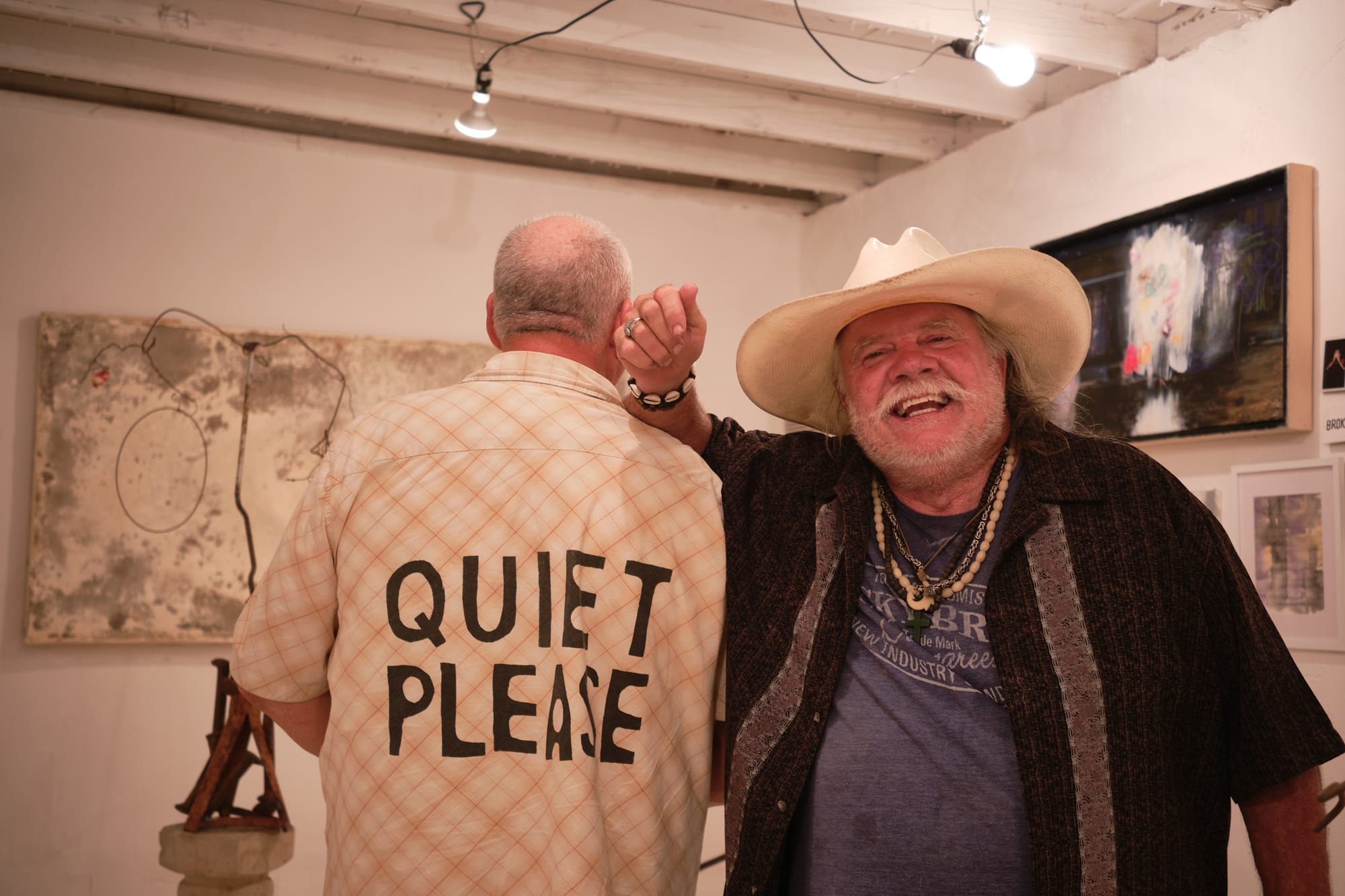
I enjoyed the great majority of the art, but I was disheartened to find that some of the art was just AI slop. These pictures actually make me feel nauseous every time I look at them:
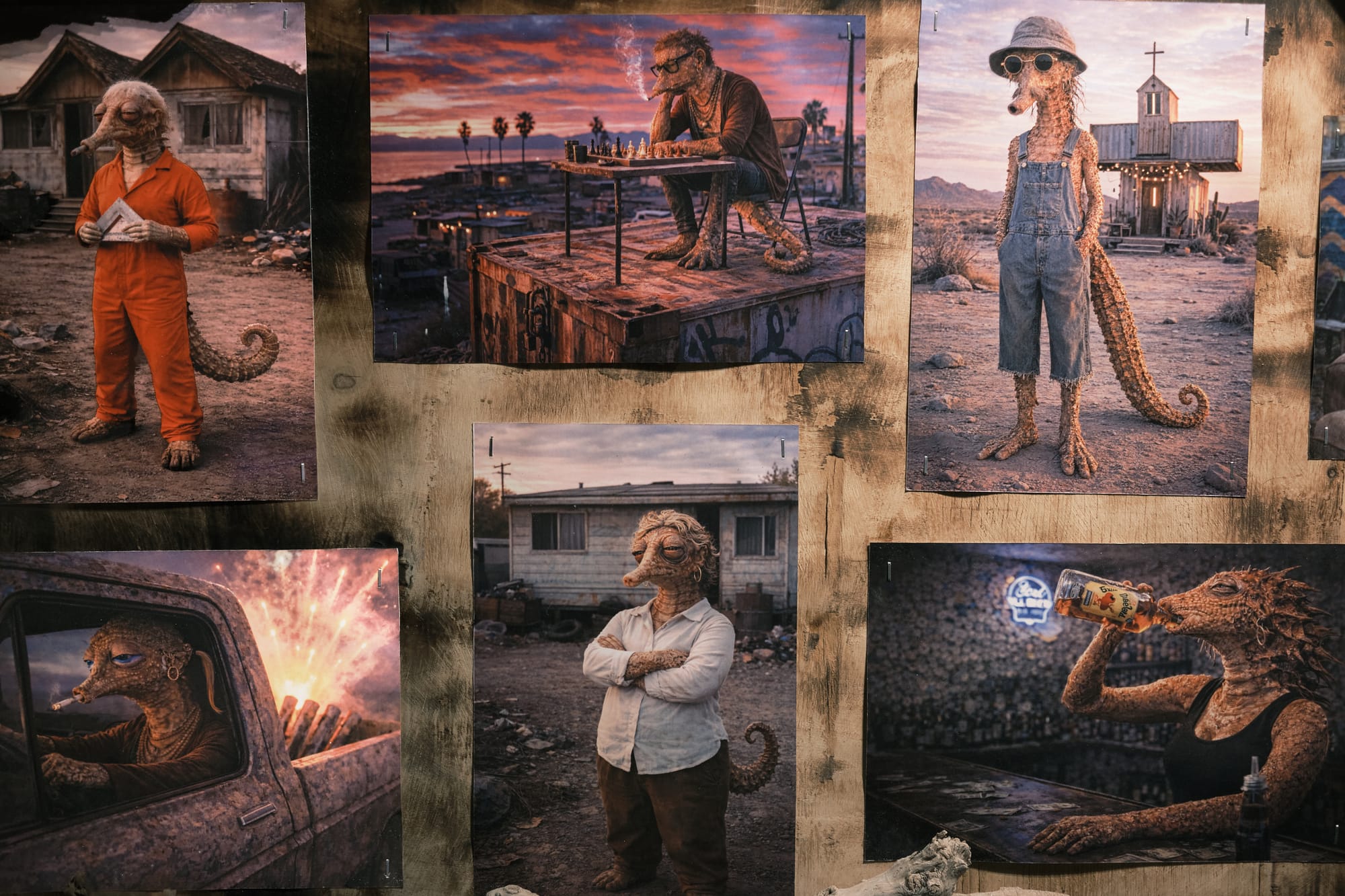
I mean, wtf?
Still, the Biennale was great, but as an alternative way of organizing society, I don’t think that top down approach led by wealthy do-gooders is a model that’s going to work. It always ends in dictatorship. An incident at the Biennale showed the way. Some people got drunk and thought it would be a good idea to drive around fast. A woman got on top of the car and was badly injured when they wrecked and she had to be helicoptered out. That led to the festival hiring security guards, which added a significant expense to a free to attend festival dependent on donations and louder pleas for attendees to donate to pay for the cost of security.
Something goes wrong, a police force is hired, taxes are raised to pay the police force, so long utopia. Turn out the lights, the party is over.
-30-