Apropos of some thing
This is another post like the last one. Just some random photos I'll pick on a whim and then publish before I have time to think much about it and make any edits. It's not some kind of best of. Just whatever interests me in this moment. I'm doing this in real time.
That's not some kind of self-criticism, btw. Spontaneity employed randomly with no pretense of meaning can be a good thing. Everything doesn't have to be precious. Normally anything I show is thought out and meaningful on multi levels. Or I could call it multi-level meaningful. Or MLM, eh. But I'm not going for that here. I'm not going for anything.
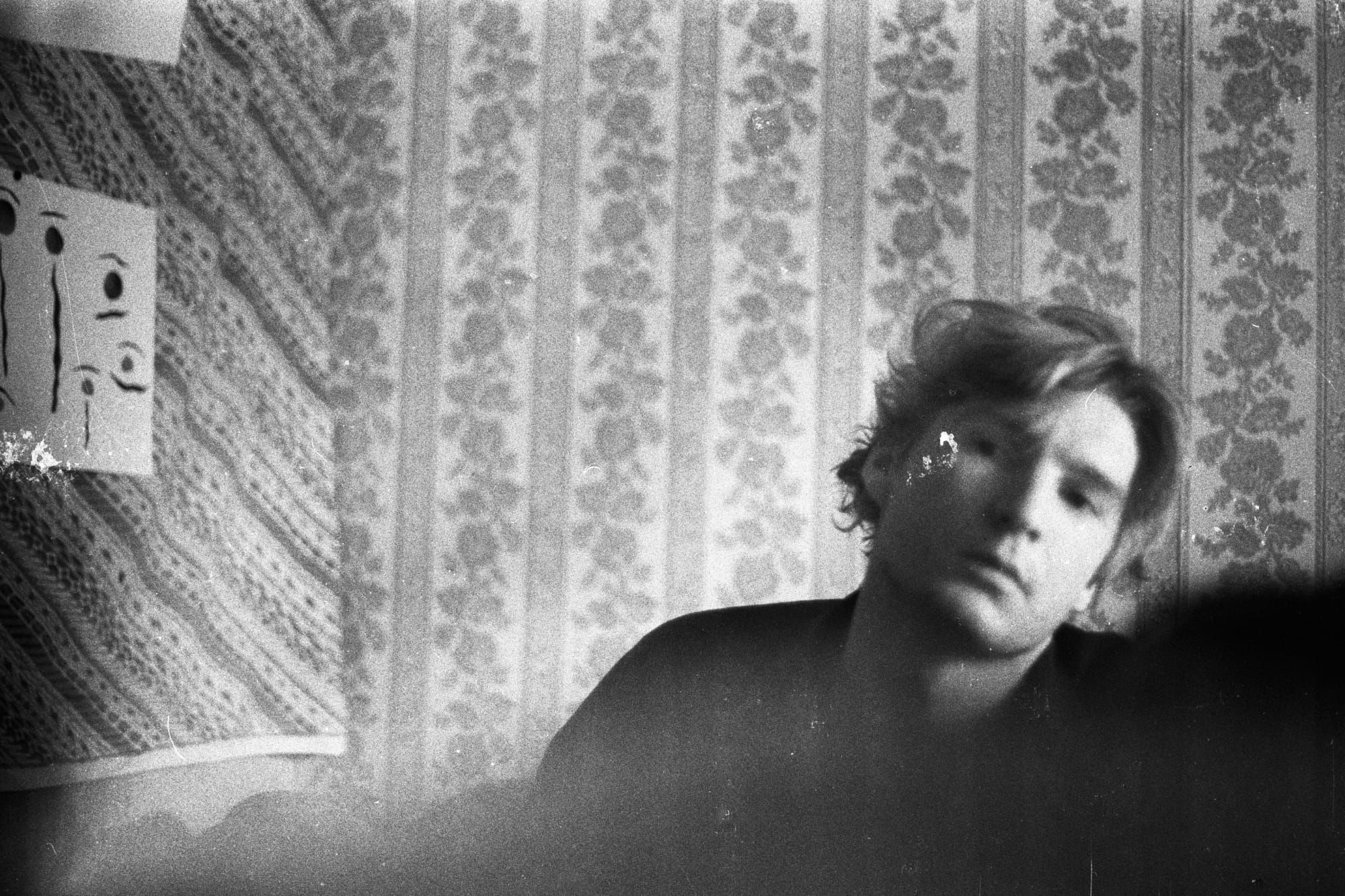
The above photo is me circa 1988 in my little room in Paris. I lived a couple blocks from the Monet Museum and spent a lot of time there on a sofa in a big circular room that had a three or four giant panel Lilly pond painting taking up about half the space. You could move to different places on the sofa and spend time with different parts of the painting. That neighborhood was weird for someone like me back then. I'm from Mount Vernon, Indiana, a toxic waste dump of a small town. The 16th Arrondissement was very upper class French. The Monet Museum was down the street around the corner and through a small woods. The immense Bois de Boulogne was on the other side. In the other direction, the Czech consulate was right next door with always a beer truck double parked and unloading cases of Pilsen Urquell. The patisserie on the corner had the best baguettes. Perfectly browned, crispy crust with willowy, cloud-like wafts of white in the spacious inner part of the crust. I was watching some show the other night and the joke was, "You've never been to Paris? Really? Then you've never eaten bread." I thought, ain't that the truth. I've tried New York, L.A., San Francisco, Seattle, D.C., and many lesser metropoli and have never found anything remotely like a Parisian baguette.
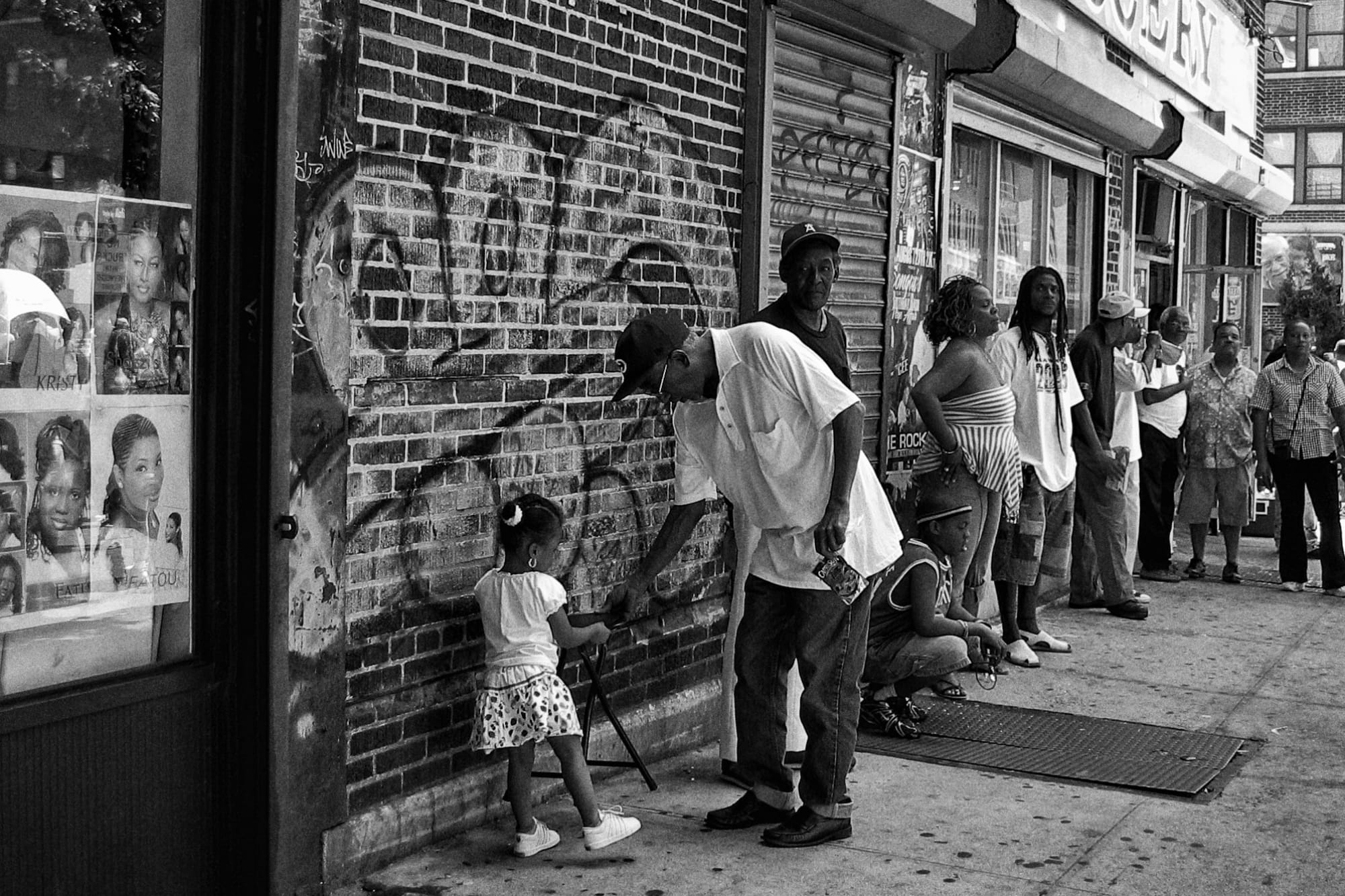
I usually don't write or even talk about a photograph but I spend a lot of time looking at them, and if I something makes me keep looking at one, I start thinking about it. I don't have any kind of detailed regimen, but in some order I think about composition, emotional feel, and meanings. If it has all of those things then I think of it in larger contexts, both within my work and in the context of the international documentary photography community. Is it original? Derivative? Of course everything has been done so where is it on the spectrum between original and derivative.
The Brooklyn street photo above comes at you in a lot of ways. Stylistically, it's a variation on the old decisive moment method. Look at all the eyes in frame. You can get disoriented trying to follow their gazes. The frame is bookended with advertising images. What's up with the white guy hiding behind the tree? Is that supposed to be me? I'm guessing not, but it works.
I did some freelance writing when I lived in Tucson and would take photos to accompany the article. Usually the publication would give me the film and develop it. My memory is fuzzy on this, but around that time I started taking a lot of desert photos for my own amusement. Cacti, succulents, Palo Verdes, and the like. I don't remember why. I got some kind of mail order film that was cut up from movie stock. They gave you the film if you paid them to process it. I wasn't trying to do professional level work and the photos weren't very good. The processing was crap and they faded and the colors turned weird almost immediately. Then somehow they got lost in the move to New York.
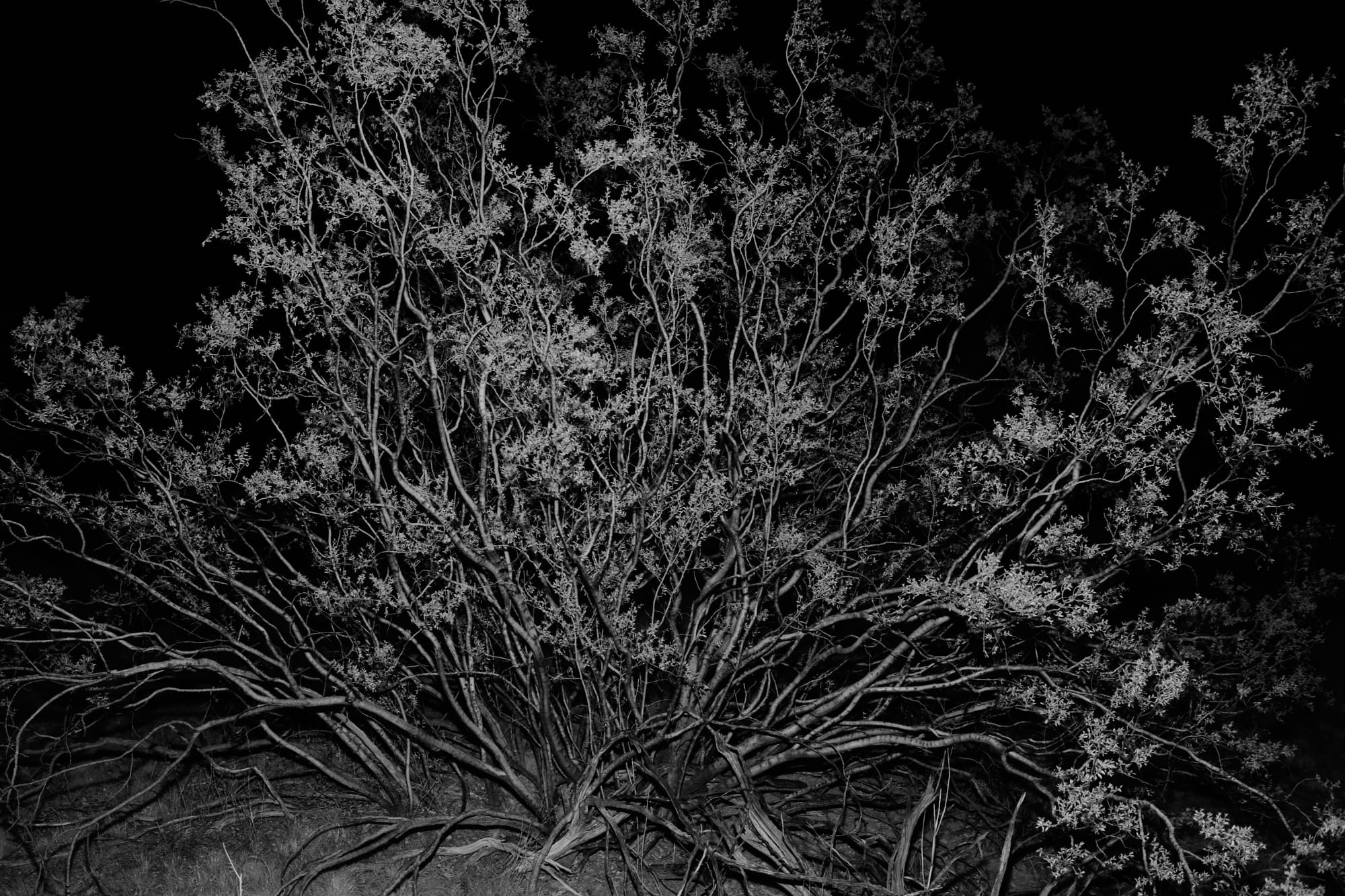
Anyway, I was in Arizona recently and took a few desert photos. I didn't think about any of that stuff from the past, but tonight it occurred to me when I thought about the above photo. I feel like I see less now than I did back then, but now I'm much better able to photograph what I see. In the above photo, I see a desert plant with an attitude. It's got something it wants to say. I like the movement against the black, the eye is drawn to both the individual and collective branches and the grey scale oscillating across them. The white splotches give the composition a subtle impressionistic element that calms the harsh realism of the majority of the composition. I don't think I'm the first to do this type of photo, but I'm pretty sure it's not a cliché. Maybe something of a dialog with Salgado about lesser stakes.
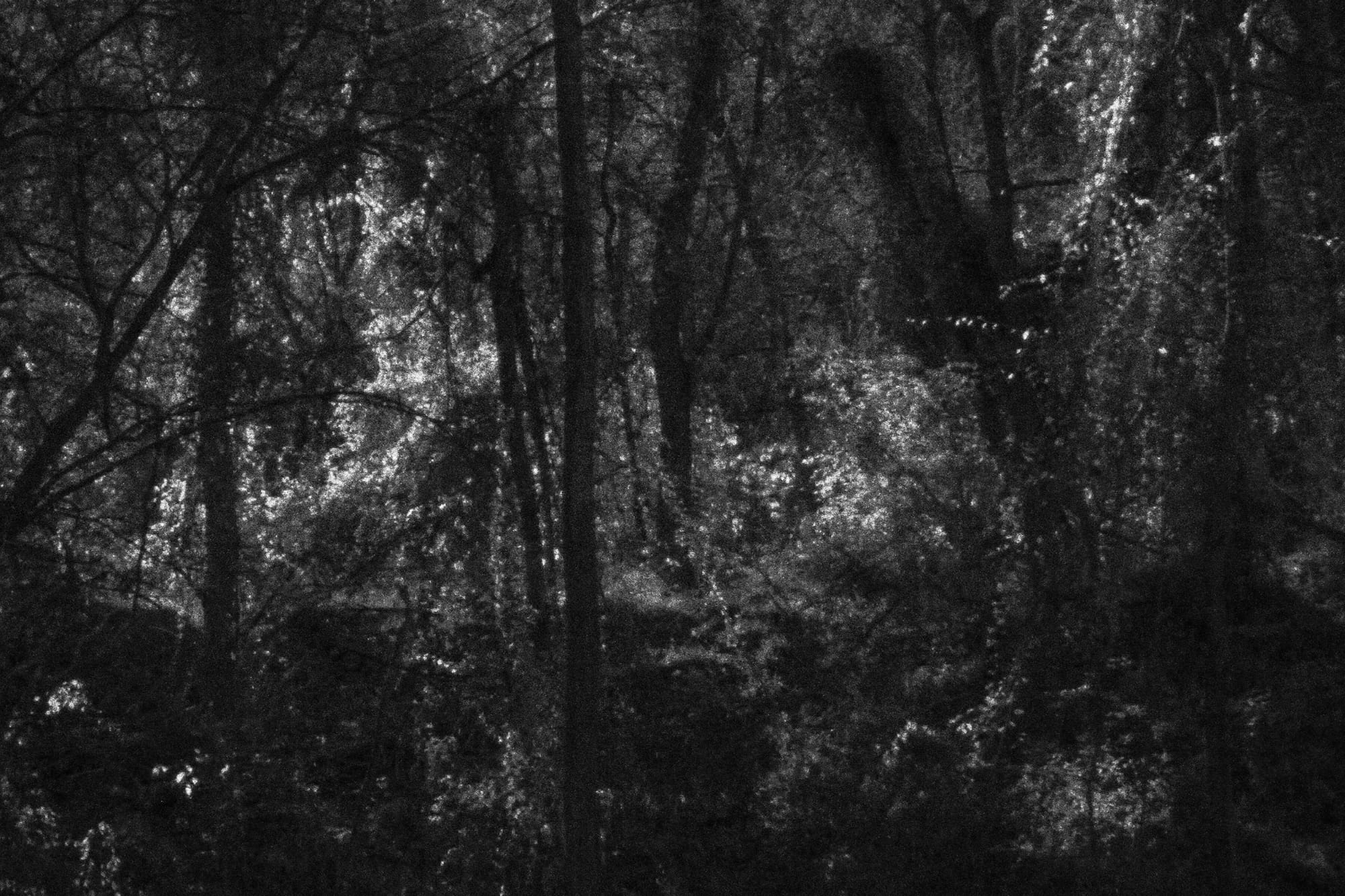
Southern Indiana is the land where the Wabash River empties into the Ohio. It is mostly flat bottomland, though there are a few hills around if you know where to look. There are a lot of swamps, which are easily the most diverse and interesting parts of the landscape. Unfortunately, swamps are abnormally unpleasant places. Intolerable heat and biting insects assault you in summer. The swamp is muddy and thorn-riddled year round. I like to go during the hottest, most humid days of summer, usually the last week of July or first week of August. That's when the light is most radical. But the suffering is great. The very best time to go doesn't come around very often, but if there is a long drought that drains the swamp and leaves the ground hard, and then it snows at least half a foot, the swamp becomes another kind of magical.
The above photo is an attempt to capture something of that, usually through the phenomenon of dappled light. I'm not sure where these kinds impressionistic photos exist in the international documentary photography world. If they exist at all, it's quite possible they are considered cliché. But as far as I can tell, they are unique to me. I've spent a lot of time and effort working on how to capture dappled light like I see it. I have a special camera for these type shots. I like this one.
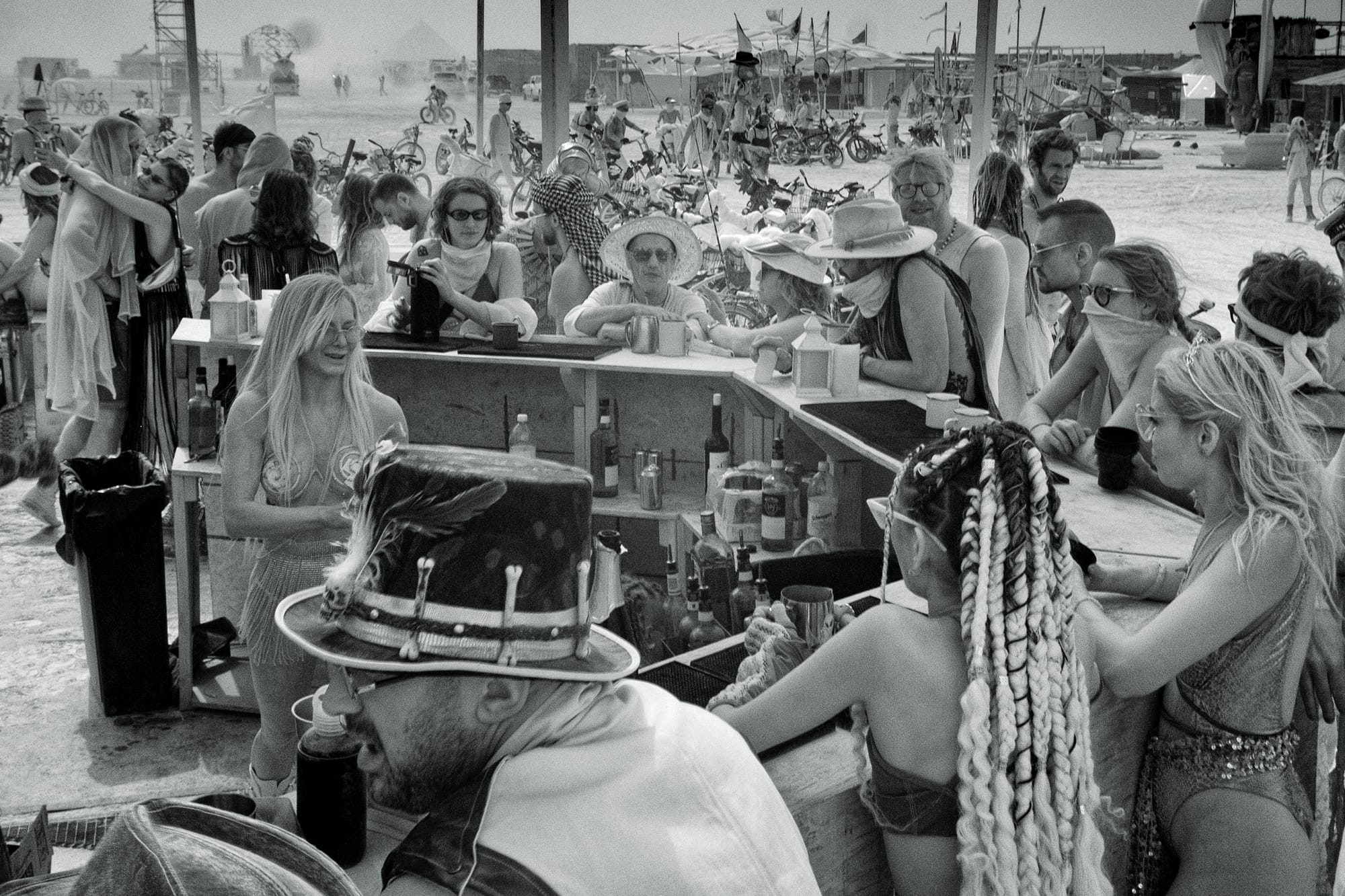
That is a photo of a bar at Burning Man in 2007, the first year I went. I had a shitty bike that was painful to ride so I didn't get out on the playa much, and certainly not deep. I mainly just walked around the local neighborhoods and went to bars, of which there were hundreds. It sounds like Burning Man is expensive because the ticket is expensive, but once you are in you do not spend any money. Every one of those hundreds of bars serves drinks for free. They often have food. Some camp always does. If you divide the ticket price by the number of days and consider what you are not having to buy, it's less than staying in a Motel 6 for a week. In 2007 I was really into alcohol and the bar pictured above was my favorite. The bar returned every year and had a lot of regulars. Sometimes a regular would drop off a bottle of top shelf liquor and the bartender would pour everyone a drink. I'm sure I drank enough that year to make up for the ticket price.
In 2007, Burning Man was a lot of different cultures. It wasn't overrun with influencer types and there was no universally identifiable Burning Man costume, though you could see the trend emerging. The last time I went in 2022 the culture was insufferable. The art was great though. Writers joke that people who say they go to Burning Man for the art or like those people in the sixties who said they read Playboy for the articles. It's all about sex, doncha know. The first time I went to Burning Man was out of curiosity and egging on from my cousin and I drank a lot. After that I went for the art and didn't drink at all. Burning Man is an art festival in a particularly barren desert. That environment is integral to the art. They feed off one another. I don't say this lightly, I hate to sound like a fucking Apple executive, but being out among the art on the playa deep into the night and early in the morning can feel truly magical. There is a sheen you can feel like waves of electricity imbued in the air and surrounding everything. I took a few photos that first year, but after that mostly lost interest in it visually.
The above photo is largely informational. The purpose was to show what that particular bar at Burning Man looked like. But outside of the literal content, the photo invites the eye to follow the snaking line from the bottom left to the upper right of the frame, giving the viewer a vaguely queasy feeling. Or one can follow the subjects' eyes and get an entirely different set of discomforting movements in and across the space of the composition.
There's other stuff to unpack as well, if you are so inclined.
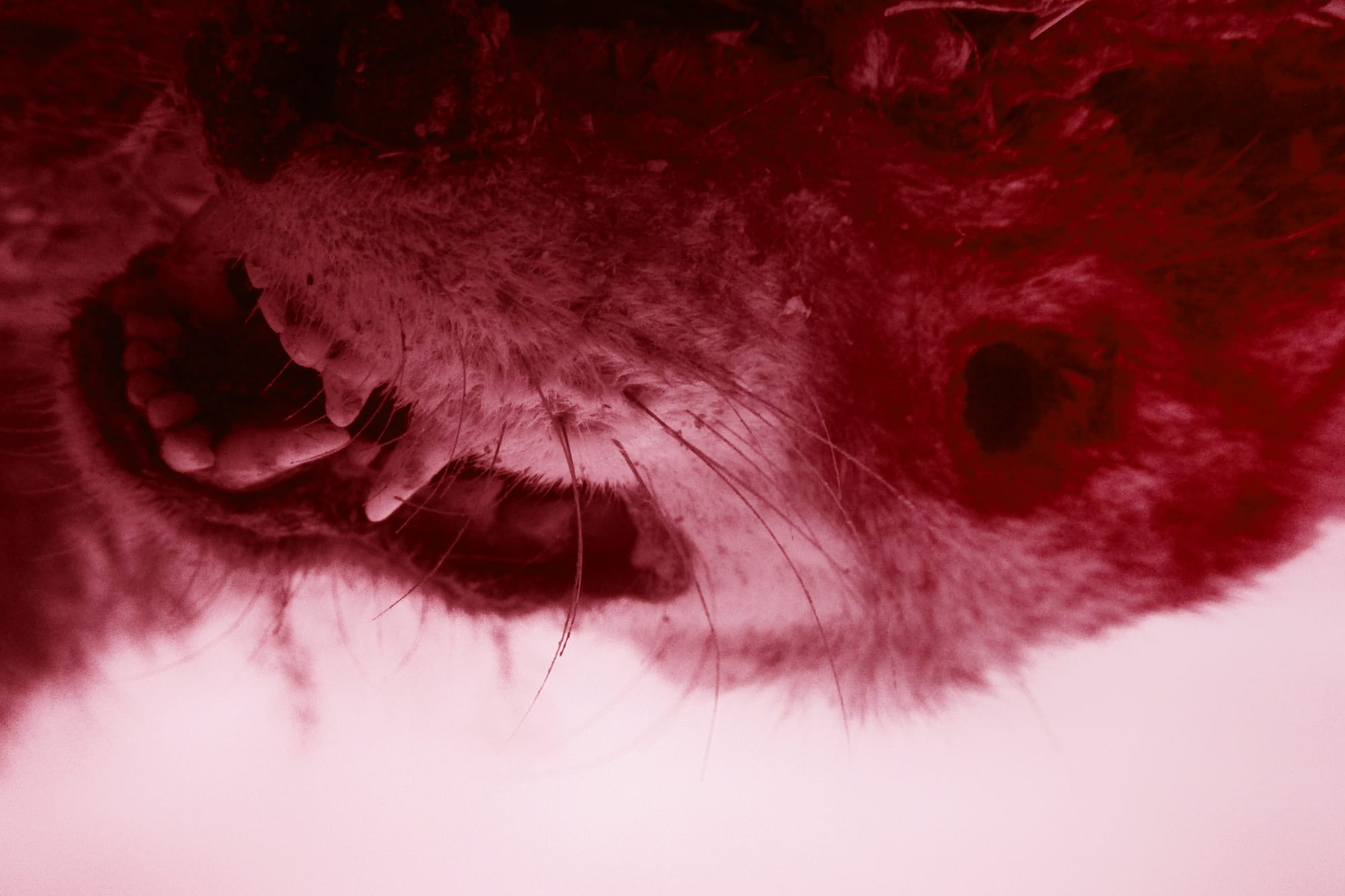
One day I was exploring backroads along the Kentucky side of the Ohio River and came across scattered animal remains in a field, probably 15 or 20 dead deer that had been cut up and many of their body parts tied up in plastic bags, and a few coyotes with their eyes gouged out. I was raised on Kentuckian jokes and am conditioned to expect the worst from the poor souls on that side of the river, so kind of took it in stride. Not everybody, sure, but in general they are a bestial folk and the apparent sexual desecrating the bodies of deer and coyote is unsurprising. I'm sure there's already a joke or two about it. Q: How does a Kentuckian get laid when his sister's out of town? A: There's always roadkill. I mean, like duh. Right?
I'm not sure what to say about the photo. As far as I'm aware, it doesn't fit anywhere in the canon of documentary photography. There's nothing to it compositionally. The color is cliché if anything. Perhaps it's too sensational? Shocking for shocking's sake? For me it's one of those images that belies any verbal description. Intellectually it is meaningless. Emotionally it may seem a bit too pat, an easy little gut punch. But I think there's something more to it, which I can't explain. That's what I like about it. It's hard to capture the last laugh, but somehow I managed.